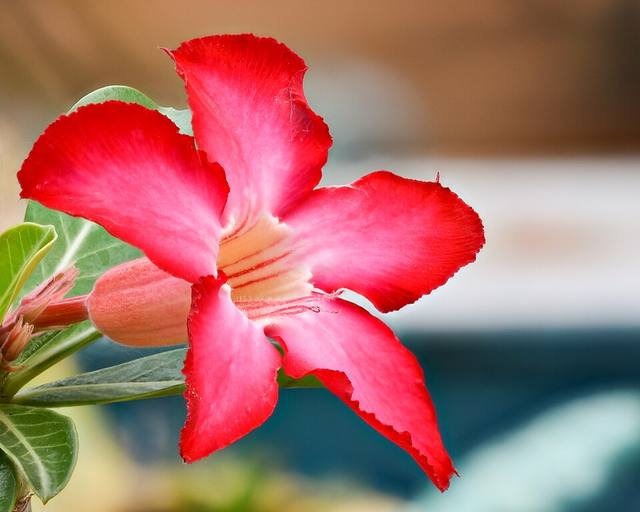
Photo: This Photo was taken by Timothy A. Gonsalves. Feel free to use my photos, but please mention me as the author. I would much appreciate if you send me an email [email protected] or write on my talk page, for my information. Please contact me before commercial use. Please do not upload an edited image here without consulting me. I would like to make corrections only at my own source to ensure that the changes improve the image and are preserved.Otherwise you may upload an edited image with a new name. Please use one of the templates derivative or extract. · CC BY-SA 4.0 · Wikimedia Commons

Desert rose
Adenium obesum
Also called Impala lily, Sabi star, Mock azalea, Kudu lily
Succulent or cactus · Family Apocynaceae · Native to Eastern and southern Africa, Arabia
A succulent with a thick, swollen base and bright pink flowers. It is slow, easy in warm, sunny places and grown as a pot plant or bonsai.
Toxic to cats and dogs
Toxic principle: Cardiac glycosides
Signs: Vomiting, diarrhea, anorexia, depression, irregular heart beat, death
Care
Light
Full sun
Full sun, at least 6 hours, to flower well. It will drop leaves and stop flowering in low light. Acclimatise slowly to full sun.
Water
About every 7 days in the growing season, every 30 in the cool season
Water thoroughly in spring and summer, as often as every week in heat, but only once dry. In winter it goes dormant and drops leaves: water very little, to stop the base rotting.
Water when the soil is dry right through
Humidity
Low humidity
Dry air is fine. It dislikes cool, damp air.
Temperature
18 to 35 °C (64 to 95 °F)
Best at 18 to 35 °C (64 to 95 °F). It is damaged below about 10 °C (50 °F). Cold and wet together is fatal.
Soil
Very gritty, free-draining mix, such as cactus compost with extra perlite or pumice. A wide pot shows off the base.
Feeding
Every 4 weeks in the growing season
Feed every 4 weeks in spring and summer with a high-potassium fertiliser. None in winter.
Repotting
Every 2 years
Repot every 2 years in spring into a slightly wider pot. Raise the swollen base for the best look. Wear gloves: sap is irritant.
Pruning
Prune in early spring to shape, as flowers form on new growth. Wear gloves and avoid getting sap on skin.
Propagation
Take a 10 cm (4 in) tip cutting in summer, let it dry for several days and root in warm, dry gritty mix. Slow to root. Seed grows quicker.
Size
30 to 120 cm (12 to 47 in)
Slow growing
Outdoors
USDA zones 10 to 12
Grows outdoors in frost-free, hot gardens in full sun. In cooler areas grow in a pot outside in summer and bring it in for winter.
Common problems
Leaves yellow and drop
Cold, overwatering, or normal winter dormancy
Check the season. Reduce water; keep warm.
Soft, black base
Root or stem rot
Stop watering; cut out soft tissue and dry it. Often fatal.
No flowers
Not enough sun, or too much nitrogen
Give full sun and a high-potassium feed.
Sticky leaves, white fluff
Mealybugs or spider mites
Wipe with alcohol; rinse leaves.
Leaves yellow in sun
Sunburn on shaded plants
Move gradually into stronger sun.
Did you know?
The thick, swollen base stores water and is called a caudex. Growers raise it above the soil to make a bonsai shape.
General care information for a typical plant. Conditions in your home or garden may need a different rhythm.
Not sure what your plant is?
Identify a plant from a photoSee this guide in the appKagn Plants also keeps your own plants with watering reminders, and its plant doctor reads what is wrong with one.
Updated 22 November 2026.