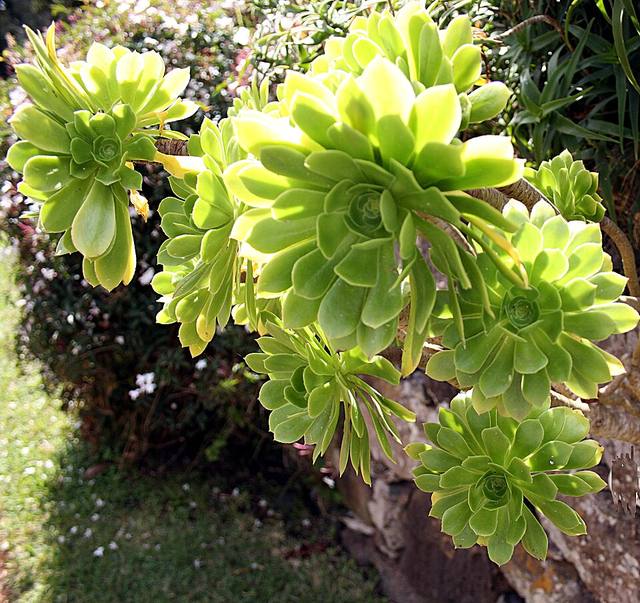
Photo: Hedwig Storch · CC BY-SA 3.0 · Wikimedia Commons

Tree aeonium
Aeonium arboreum
Also called Tree houseleek, Irish rose, Black rose (purple form)
Succulent or cactus · Family Crassulaceae · Native to Morocco (probably; widely grown)
A branching succulent with rosettes of glossy leaves on bare, woody stems. Purple types such as Schwarzkopf are popular for their near-black leaves.
Not on the ASPCA's list: keep it out of reach of pets.
Care
Light
Full sun
Bright light with some direct sun for good colour. Indoors give the brightest window. In dim light it stretches and the rosettes open flat and pale.
Water
About every 10 days in the growing season, every 21 in the cool season
It grows in the cool wet season and rests in hot summers. Water deeply in autumn to spring, and very little in hot weather, when rosettes close tightly to save water.
Water when the soil is dry; leaves curl if too dry
Humidity
Low humidity
Dry air is fine.
Temperature
10 to 24 °C (50 to 75 °F)
Best at 10 to 24 °C (50 to 75 °F). Frost damages it; below about -3 °C (27 °F) it dies. Rests in heat above 30 °C (86 °F).
Soil
Gritty cactus mix with extra perlite or grit. Drainage holes are essential.
Feeding
Every 6 weeks in the growing season
Feed every 6 weeks in its growing season, autumn to spring, with half-strength fertiliser.
Repotting
Every 3 years
Repot every 3 years in autumn or spring when top-heavy. A heavy pot stops it tipping.
Pruning
Cut leggy stems back to a node. A beheaded rosette puts out new branches below the cut.
Propagation
Cut a rosette with 5 cm (2 in) of stem, let it dry for several days and stand it on gritty mix. It roots in a few weeks.
Size
30 to 100 cm (12 to 39 in)
Medium growth
Outdoors
USDA zones 9 to 11
Grows outdoors in frost-free, mild climates in sun or light shade. Elsewhere keep in pots and bring them in for winter.
Common problems
Leaves curled and rosette closed
Heat or drought
Water deeply in cool season; in summer shade a little and water sparingly.
Lower leaves dry and fall
Natural ageing
Remove dead leaves. If many fall, check for overwatering.
Stretched stems, flat green rosette
Low light
Move to a brighter place; behead and re-root to restart.
Stem soft at the base
Overwatering
Cut above the rot and root the top again.
Black patches on leaves
Frost or cold wet
Keep it above freezing and avoid cold, wet soil.
Did you know?
It grows in winter, the opposite of most succulents. It rests in summer, closing its rosettes to save water.
General care information for a typical plant. Conditions in your home or garden may need a different rhythm.
Not sure what your plant is?
Identify a plant from a photoSee this guide in the appKagn Plants also keeps your own plants with watering reminders, and its plant doctor reads what is wrong with one.
Updated 22 November 2026.