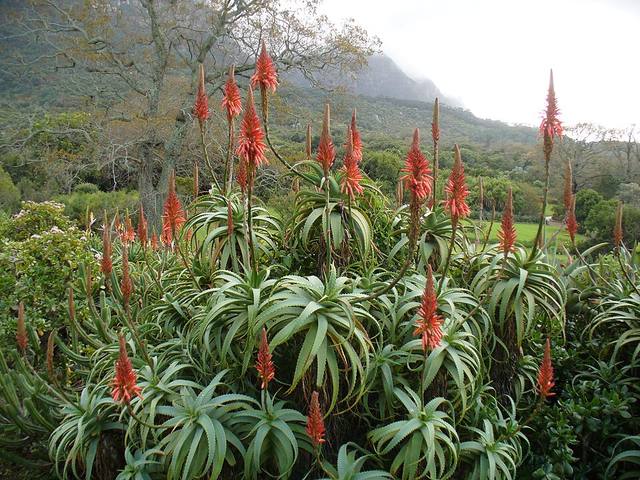
Photo: Andrew massyn · Public domain · Wikimedia Commons

Candelabra aloe
Aloe arborescens
Also called Tree aloe, Krantz aloe, Torch aloe
Succulent or cactus · Family Asphodelaceae · Native to South-eastern Africa
A large, branching aloe with grey-green leaves edged with soft teeth. It makes a big shrub outdoors and bright orange-red flower spikes in winter.
The ASPCA lists a close relative, aloe (Aloe vera), as toxic to cats and dogs: treat this plant the same.
Care
Light
Full sun
Full sun to bright light. In shade it stretches and flowers poorly. Needs the brightest window indoors; outdoors it thrives in direct sun.
Water
About every 14 days in the growing season, every 35 in the cool season
Water deeply, then let it dry. It stores water, so drought is better than damp. Soft, yellow leaves mean too much water. Keep nearly dry in cool winters.
Water when the soil is dry to 5 cm (2 in)
Humidity
Low humidity
Dry air is fine.
Temperature
10 to 30 °C (50 to 86 °F)
Best at 10 to 30 °C (50 to 86 °F). Tolerates a light frost to about -4 °C (25 °F) when dry.
Soil
Gritty, sandy, free-draining mix; poor soil is fine. Drainage holes are essential.
Feeding
Every 8 weeks in the growing season
Feed every 8 weeks in spring and summer with a half-strength cactus fertiliser. None in winter.
Repotting
Every 3 years
Repot every 3 years in spring into a heavy pot; it grows tall and tips. Wear gloves for the sharp teeth.
Pruning
Remove dead leaves and flower stalks after flowering. Cut leggy stems back to encourage branching.
Propagation
Cut a branch with a few leaves, let it dry for several days, and plant in dry gritty mix. It roots in weeks. Or split off the many offsets.
Size
100 to 300 cm (39 to 118 in)
Medium growth
Outdoors
USDA zones 9 to 11
Grows outdoors in frost-free or mildly frosty areas in full sun on well-drained soil. Space 1 m (3 ft) apart. Common in hedges.
Common problems
Leaves soft and yellow
Overwatering
Let the soil dry and improve drainage; cut off rotted leaves.
Stretched, leaning stems
Low light
Move to full sun and support or cut back.
Brown, scorched leaf tips
Sudden strong sun or cold
Acclimatise gradually.
No flowers
Too little sun or too warm in winter
Give full sun and a cooler winter to flower.
White cottony pests
Mealybugs or scale
Wipe with alcohol on a cotton bud.
Did you know?
It flowers in the middle of winter in its native range, when its orange-red spikes are visited by sunbirds.
General care information for a typical plant. Conditions in your home or garden may need a different rhythm.
Not sure what your plant is?
Identify a plant from a photoSee this guide in the appKagn Plants also keeps your own plants with watering reminders, and its plant doctor reads what is wrong with one.
Updated 22 November 2026.