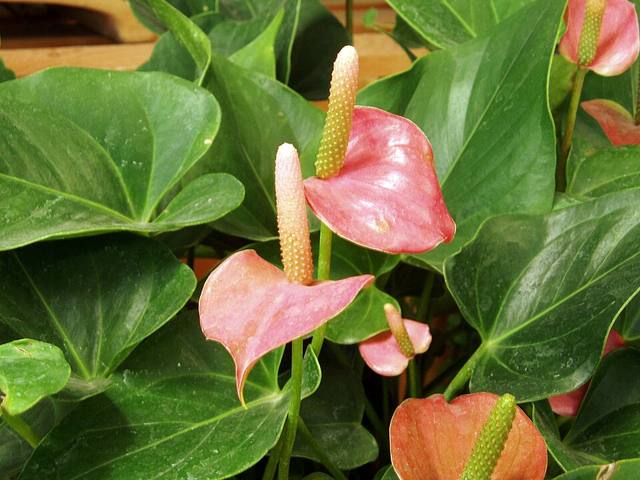
Photo: Taken by Fanghong · CC BY 2.5 · Wikimedia Commons

Flamingo flower
Anthurium andraeanum
Also called Anthurium, Tailflower, Painted tongue
Houseplant · Family Araceae · Native to Colombia and Ecuador
A tropical plant with glossy, heart-shaped leaves and shiny red, pink or white 'flowers' that are really coloured leaves around a spike. It blooms for months.
The ASPCA lists a close relative, flamingo Flower (Anthurium scherzeranum), as toxic to cats and dogs: treat this plant the same.
Care
Light
Bright, indirect light
Bright indirect light to medium light. Direct sun scorches the leaves and the spathes. Low light stops flowering.
Water
About every 7 days in the growing season, every 12 in the cool season
Water lightly and let the top dry; the roots are fleshy and rot in soggy soil. Use soft water if you can. Yellow leaves with wet soil mean overwatering.
Water when the top 3 cm (1 in) of soil is dry
Humidity
High humidity
Likes humid air. Brown spots and tips mean dry air. A humidifier or pebble tray helps.
Temperature
18 to 28 °C (64 to 82 °F)
Keep at 18 to 28 °C (64 to 82 °F). It is damaged below about 12 °C (54 °F) and hates cold draughts.
Soil
Very airy mix: orchid bark, perlite and a little potting mix. The pot needs drainage holes. Slightly acidic is ideal.
Feeding
Every 4 weeks in the growing season
Feed every 4 weeks in spring and summer with a half-strength, bloom-type fertiliser. Over-feeding burns leaf tips.
Repotting
Every 2 years
Repot every 2 years in spring, one size up. It is happy a little root-bound.
Pruning
Cut off old flowers and yellow leaves at the base. Do not cut healthy aerial roots.
Propagation
Divide a clump in spring, keeping roots on each piece. Top cuttings with aerial roots can be rooted in damp moss. Seed is slow.
Size
30 to 70 cm (12 to 28 in)
Slow growing
Outdoors
USDA zones 10 to 12
Grows outdoors in frost-free, humid shade. Elsewhere keep it indoors.
Common problems
No new flowers
Low light or too little feed
Move to brighter indirect light and feed lightly in spring.
Yellow leaves
Overwatering
Let the top 3 cm dry and empty the saucer.
Brown spots and tips
Dry air or cold draughts
Raise humidity and move away from vents.
Flowers fade to green
Age
Normal after a few months; cut them off at the base.
Scorched patches
Direct sun
Move it out of direct sun.
Did you know?
The colourful 'flower' is a leaf called a spathe. The true flowers are the tiny dots on the spike in the middle.
General care information for a typical plant. Conditions in your home or garden may need a different rhythm.
Not sure what your plant is?
Identify a plant from a photoSee this guide in the appKagn Plants also keeps your own plants with watering reminders, and its plant doctor reads what is wrong with one.
Updated 22 November 2026.