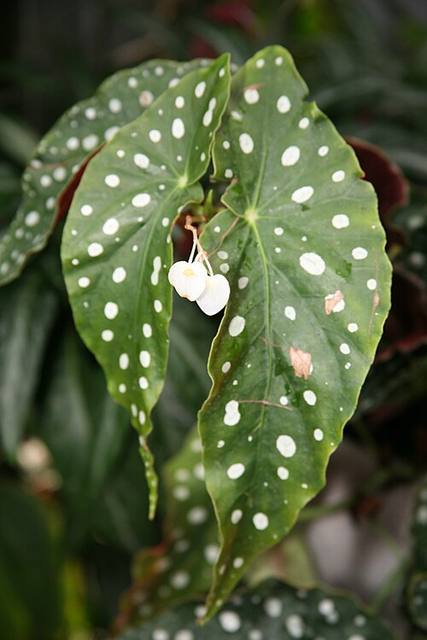
Photo: Cliff from I now live in Arlington, VA (Outside Washington DC), USA · CC BY 2.0 · Wikimedia Commons

Polka dot begonia
Begonia maculata
Also called Angel wing begonia, Spotted begonia, Trout begonia
Houseplant · Family Begoniaceae · Native to Brazil (Atlantic forest)
A tall, cane-like begonia with olive-green angel-wing leaves spotted in silver, red beneath. It is striking but sulks over dry air and soggy soil.
Toxic to cats and dogs
Toxic principle: Soluble calcium oxalates
Signs: Kidney failure (in grazing animals), vomiting, salivation in dogs/cats. Most toxic part is underground
Care
Light
Bright, indirect light
Bright, filtered light, with gentle morning sun. Too little light fades the spots and makes it leggy. Direct sun scorches the leaves.
Water
About every 7 days in the growing season, every 12 in the cool season
Water well, then let the top dry. Water on the leaves can leave marks and mildew. Soggy soil rots the stems.
Water when the top 3 cm (1 in) of soil is dry
Humidity
High humidity
It likes humid air, ideally above 50 %. Dry air gives crisp leaf edges. Use a tray of pebbles or group plants, and do not mist.
Temperature
18 to 26 °C (64 to 79 °F)
Grows best at 18 to 26 °C (64 to 79 °F). Damaged below about 10 °C (50 °F) and sulks in cold draughts.
Soil
A light, airy, well-draining potting mix with perlite and bark. Drainage holes are a must. A small pot suits it.
Feeding
Every 4 weeks in the growing season
Feed every 4 weeks in spring and summer with a half-strength houseplant feed. Skip it in winter.
Repotting
Every 2 years
Repot every 2 years in spring, only one size up. It prefers being snug.
Pruning
Pinch or cut back tall canes in spring to make it bushy, cutting just above a node. Remove dead leaves. It gets top-heavy, so stake tall stems.
Propagation
Take 10 cm (4 in) stem cuttings with a node and root them in water or damp mix. Roots come in 3 to 5 weeks.
Size
60 to 150 cm (24 to 59 in)
Fast growing
Outdoors
USDA zones 10 to 11
Grows outdoors only in frost-free, humid, shady spots. Elsewhere keep it indoors.
Common problems
Crisp, brown leaf edges
Dry air or irregular watering
Raise humidity and keep the soil evenly moist.
White powder on the leaves
Powdery mildew
Improve airflow, keep water off the leaves, and remove the worst leaves.
Tall, bare, floppy canes
Low light or no pruning
Prune back in spring and move to brighter light.
Yellow leaves, soft stem base
Overwatering
Let the soil dry, and check the pot drains.
Faded spots
Not enough light
Move it to a brighter spot, out of hot sun.
Did you know?
The undersides of the leaves are deep red, and the plant can flower with drooping clusters of white or pink blooms several times a year.
General care information for a typical plant. Conditions in your home or garden may need a different rhythm.
Not sure what your plant is?
Identify a plant from a photoSee this guide in the appKagn Plants also keeps your own plants with watering reminders, and its plant doctor reads what is wrong with one.
Updated 22 November 2026.