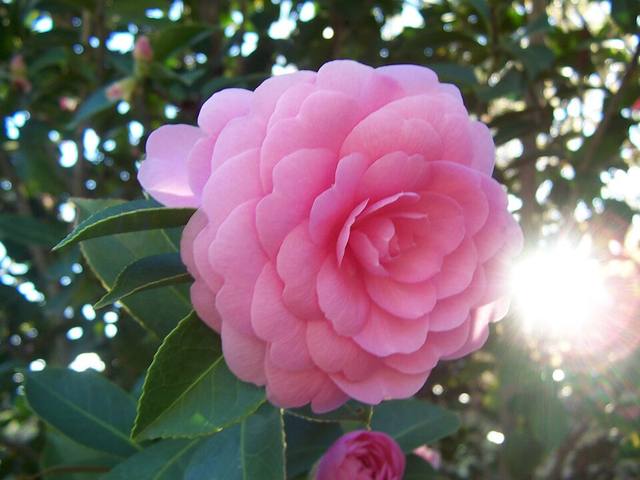
Photo: User:Fir0002 (assumed by Wikimedia Commons) · CC BY-SA 3.0 · Wikimedia Commons

Japanese camellia
Camellia japonica
Also called Common camellia, Camellia, Tsubaki
Shrub · Family Theaceae · Native to Japan, Korea and eastern China
A slow evergreen shrub with glossy dark leaves and large rose-like flowers from late winter to spring. It is grown in sheltered, shaded spots in acid soil.
The ASPCA lists this plant as non-toxic to cats and dogs
Care
Light
Part sun
Dappled shade or morning sun with shelter from hot afternoon sun and cold winds. Too much sun scorches leaves, and sun on frosted blooms browns them.
Water
About every 7 days in the growing season, every 14 in the cool season
Keep the soil evenly damp, especially from midsummer to autumn when flower buds form. Dry spells then cause bud drop. Use rainwater if your tap water is hard. Do not let it get soggy.
Water when the top 3 to 5 cm (1 to 2 in) of soil is dry
Humidity
Medium humidity
Average air is fine. Indoors it needs a cool room and humid air.
Temperature
8 to 25 °C (46 to 77 °F)
Hardy to about -12 °C (10 °F). Flower buds can be damaged by hard frost, and a freeze followed by morning sun browns open flowers.
Soil
Moist, humus-rich, well-drained, acid soil, about pH 5.5 to 6.5. Add ericaceous compost and mulch with leaf mould. Plant with the root ball level or a little proud.
Feeding
Every 6 weeks in the growing season
Feed in spring after flowering with a feed for acid-loving plants, every 6 weeks until midsummer. Stop after that.
Repotting
Every 3 years
A potted plant needs repotting every 3 years, in spring after flowering, into ericaceous compost. In the ground it is left alone.
Pruning
Prune little. Cut after flowering in spring to shape or remove dead wood. Heavy pruning reduces next year's flowers.
Propagation
Take semi-ripe cuttings 8 to 10 cm (3 to 4 in) long in late summer and root them in gritty mix with warmth. It takes a few months. Layering also works.
Size
150 to 500 cm (59 to 197 in)
Slow growing
Outdoors
USDA zones 7 to 9
Plant in sheltered shade, out of morning sun on frosty days. Space 1.5 to 3 m (5 to 10 ft) apart. It grows well in large pots.
Common problems
Flower buds drop before opening
Dry or too wet soil, cold or sudden changes
Keep soil evenly damp from summer on. Avoid moving the pot.
Yellow leaves with green veins
Soil too alkaline
Feed with a feed for acid-loving plants and water with rainwater. Check the pH.
Brown flowers, brown patch on petals
Camellia petal blight
Pick up and bin fallen petals, remove infected flowers and mulch.
Sooty, sticky leaves
Scale insects
Wipe with soapy water and remove heavy infestations.
Scorched brown leaves
Too much sun or wind
Move to shelter and shade.
Did you know?
Camellia japonica is a close relative of the tea plant, Camellia sinensis. In Japan its seeds are pressed into tsubaki oil, used on hair and for polishing wood.
General care information for a typical plant. Conditions in your home or garden may need a different rhythm.
Not sure what your plant is?
Identify a plant from a photoSee this guide in the appKagn Plants also keeps your own plants with watering reminders, and its plant doctor reads what is wrong with one.
Updated 22 November 2026.