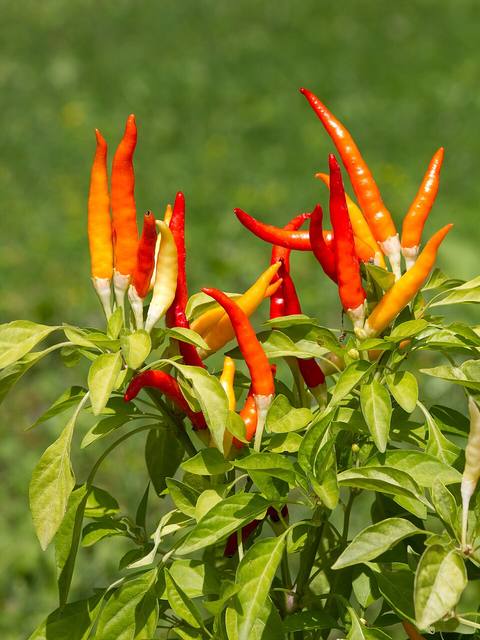
Photo: PierreSelim · CC BY 3.0 · Wikimedia Commons

Pepper
Capsicum annuum
Also called Chilli, Chili pepper, Sweet pepper, Bell pepper, Paprika
Vegetable · Family Solanaceae · Native to Mexico and Central America
The plant behind sweet peppers and most hot chillies. It is grown as a warm-season crop in the ground, in containers, or as a sunny windowsill plant.
Not on the ASPCA's list: keep it out of reach of pets.
Care
Light
Full sun
Full sun, at least 6 to 8 hours. In shade it grows leggy and sets little fruit. Flowers drop when it is too hot or too cold.
Water
About every 3 days in the growing season, every 7 in the cool season
Water deeply and evenly; irregular watering causes flowers to drop and fruit to crack. In winter, a potted plant that is kept alive needs far less. Outdoors it is grown as a summer crop, so use the summer interval.
Water when the top 2 to 3 cm (1 in) of soil is dry
Humidity
Medium humidity
Normal humidity is fine. Very dry, hot air can drop flowers.
Temperature
20 to 30 °C (68 to 86 °F)
Best at 20 to 30 °C (68 to 86 °F). Frost kills it and growth stalls below about 10 °C (50 °F).
Soil
Rich, well-drained soil or compost, pH 6.0 to 6.8. In pots use a 10 to 20 litre container that drains well.
Feeding
Every 2 weeks in the growing season
Feed with a high-potash tomato fertiliser every 2 weeks once flowers form. Too much nitrogen gives leaves and few fruit.
Repotting
Sow each spring and plant out after frost, or pot on seedlings once or twice. In frost-free areas a plant can be kept for years.
Pruning
Pinch the top when it is 20 cm (8 in) tall to make it bushy. Remove the first flowers for a stronger plant if you want.
Propagation
Sow seed indoors 8 to 10 weeks before the last frost at 21 to 27 °C (70 to 80 °F). Seeds take 1 to 3 weeks to sprout.
Size
40 to 100 cm (16 to 39 in)
Medium growth
Outdoors
USDA zones 2 to 11
Grown as a summer annual almost anywhere, in a sunny, sheltered spot, 40 to 60 cm (16 to 24 in) apart. It is perennial only in frost-free zones.
Eating
Fruit, ripe or unripe: sweet peppers and chillies.
Hot chillies burn skin and eyes, so wash hands after handling and keep them away from your face.
Common problems
Flowers drop without making fruit
Heat, cold or uneven watering
Keep nights above 13 °C (55 °F) and water evenly.
Black, sunken patch on fruit
Blossom end rot, from uneven watering
Water evenly and mulch; pick off bad fruit.
Yellow leaves
Overwatering or hunger
Let the soil dry slightly and feed once flowering starts.
Curled leaves, sticky leaves
Aphids
Wash them off with water or soapy spray and check weekly.
Slow growth
Cold nights
Wait for warm weather, or grow in a warm sheltered place.
Did you know?
The heat of a chilli comes from capsaicin, which mostly sits in the white pith that holds the seeds, not in the seeds. Birds feel no heat from it, which helps spread the seed.
General care information for a typical plant. Conditions in your home or garden may need a different rhythm.
Not sure what your plant is?
Identify a plant from a photoSee this guide in the appKagn Plants also keeps your own plants with watering reminders, and its plant doctor reads what is wrong with one.
Updated 22 November 2026.