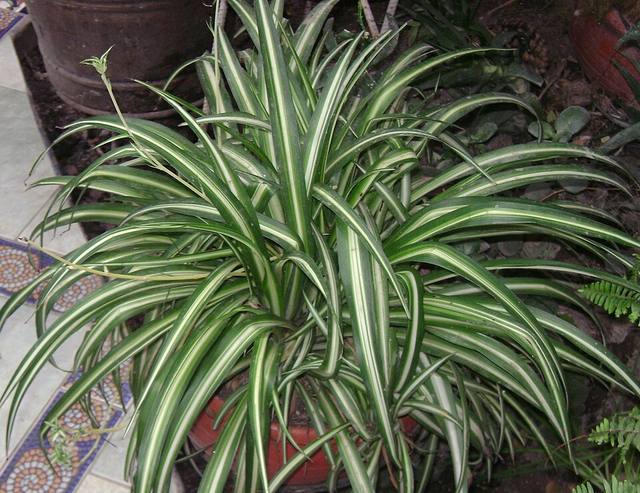
Photo: Dtarazona; derivative work: Peter coxhead · Public domain · Wikimedia Commons

Spider plant
Chlorophytum comosum
Also called Ribbon plant, Airplane plant, Spider ivy
Houseplant · Family Asparagaceae · Native to Tropical and southern Africa
A cheerful plant with arching green or striped leaves that sends out long stems with baby plantlets. It is easy, fast and nearly impossible to kill.
The ASPCA lists this plant as non-toxic to cats and dogs
Care
Light
Bright, indirect light
Bright indirect light; it also copes with medium light. Plain green forms take lower light. Direct sun browns the leaves, and dim light stops plantlets forming.
Water
About every 7 days in the growing season, every 14 in the cool season
Water well and let the top dry a little. Its fleshy roots store water, so soggy soil is worse than a missed watering. Brown tips often come from fluoride in tap water.
Water when the top 2.5 cm (1 in) of soil is dry
Humidity
Medium humidity
Average home humidity is fine. Very dry air can brown the leaf tips.
Temperature
13 to 27 °C (55 to 81 °F)
Best at 13 to 27 °C (55 to 81 °F). Below 7 °C (45 °F) leaves are damaged.
Soil
Ordinary, well-draining potting mix. The pot must have drainage holes.
Feeding
Every 4 weeks in the growing season
Feed every 4 weeks in spring and summer with a diluted fertiliser. Too much fertiliser browns the tips.
Repotting
Every 1 year
Repot every year or two: the thick roots quickly fill the pot. Move up one size in spring.
Pruning
Cut off brown leaves at the base. Snip off a stem once the plantlets are rooted if you want a tidier plant.
Propagation
Pot up a plantlet on its stem, or snip it off and stand it in water or moist soil. Roots form within 2 to 3 weeks.
Size
20 to 40 cm (8 to 16 in)
Fast growing
Outdoors
USDA zones 9 to 11
Outdoors in frost-free climates as a shade ground cover. In cold regions use it in summer pots and bring it in.
Common problems
Brown leaf tips
Fluoride or salts in water, or dry air
Use rainwater or filtered water; flush the soil every few months.
Pale, faded stripes
Too much sun
Move out of direct sun.
No baby plantlets
Too little light or a young plant
Give brighter light and a slightly snug pot.
Yellow leaves
Overwatering
Let the soil dry a bit more between waterings.
Brown, crispy leaves
Underwatering or heat
Water more evenly and move from a hot spot.
Did you know?
The dangling plantlets are exact clones, and a mother plant can make dozens in a season. It is why the plant was given its spider name.
General care information for a typical plant. Conditions in your home or garden may need a different rhythm.
Not sure what your plant is?
Identify a plant from a photoSee this guide in the appKagn Plants also keeps your own plants with watering reminders, and its plant doctor reads what is wrong with one.
Updated 22 November 2026.