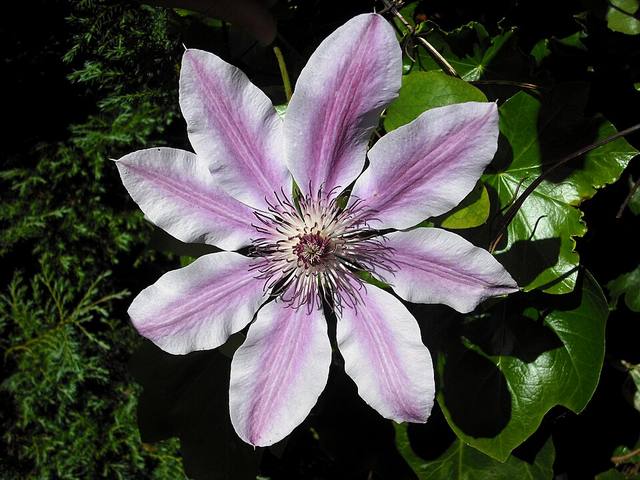
Photo: Jolly Janner · Public domain · Wikimedia Commons

Clematis
Clematis
Also called Traveller's joy, Virgin's bower, Old man's beard
Garden flower · Family Ranunculaceae · Native to Temperate regions of the northern hemisphere
A climber with large or nodding flowers that scrambles up fences, trellises and shrubs. It flowers from spring to autumn depending on the group, and it likes cool roots.
Toxic to cats and dogs
Toxic principle: Irritant glycoside (Protoanemonin)
Signs: Salivation, vomiting, diarrhea.
Care
Light
Part sun
Its head wants sun, 6 hours, but its roots need shade. Plant a low shrub or mulch at its base.
Water
About every 5 days in the growing season, every 21 in the cool season
Water deeply once a week in dry weather for the first two years. Clematis dislikes soggy soil. Plants against walls can be dry under the eaves. Water less in winter.
Water when the top 5 cm (2 in) of soil is dry
Humidity
Medium humidity
Outdoor humidity is no concern. Good air flow helps prevent wilt and mildew.
Temperature
5 to 24 °C (41 to 75 °F)
Most garden types are hardy to -29 °C (-20 °F) or lower. Evergreen types are less hardy. Best at 5 to 24 °C (41 to 75 °F).
Soil
Rich, well-drained soil with plenty of compost, neutral to slightly alkaline. Plant the crown 5 to 8 cm (2 to 3 in) deep to guard against wilt.
Feeding
Every 4 weeks in the growing season
Feed every 4 weeks in spring and summer with a high-potash feed. Mulch with compost in spring.
Repotting
Not divided. Plant in the ground or in a large pot of 45 cm (18 in) or more, and top-dress each year.
Pruning
Pruning depends on the group. Group 1 flowers on old wood: prune after flowering. Group 2: tidy in late winter. Group 3: cut to 30 cm (12 in) in late winter.
Propagation
Layer a long stem into a pot in summer. Or take softwood cuttings of a node pair. Both are slow, so most people buy a plant.
Size
200 to 600 cm (79 to 236 in)
Fast growing
Outdoors
USDA zones 4 to 9
Hardy in zones 4 to 9, depending on type. Plant next to a trellis or wire and space plants at least 1 m (3 ft) apart.
Common problems
Whole stem wilts and dies suddenly
Clematis wilt (fungus)
Cut the stem to healthy growth, down to ground level if needed. It often regrows from the base. Plant deep.
Few flowers
Wrong pruning, too much shade or too little feed
Check your pruning group and give the top 6 hours of sun and a high-potash feed.
Brown leaf edges, buds fall
Dry roots
Mulch and water deeply.
White powder on leaves
Powdery mildew
Give more air, water at the base and cut back affected stems.
Slugs eat young shoots
Slugs and snails
Check at night and protect new growth in spring.
Did you know?
The seed heads of many clematis are fluffy silver tufts, which gave the wild European species its name of old man's beard.
General care information for a typical plant. Conditions in your home or garden may need a different rhythm.
Not sure what your plant is?
Identify a plant from a photoSee this guide in the appKagn Plants also keeps your own plants with watering reminders, and its plant doctor reads what is wrong with one.
Updated 22 November 2026.