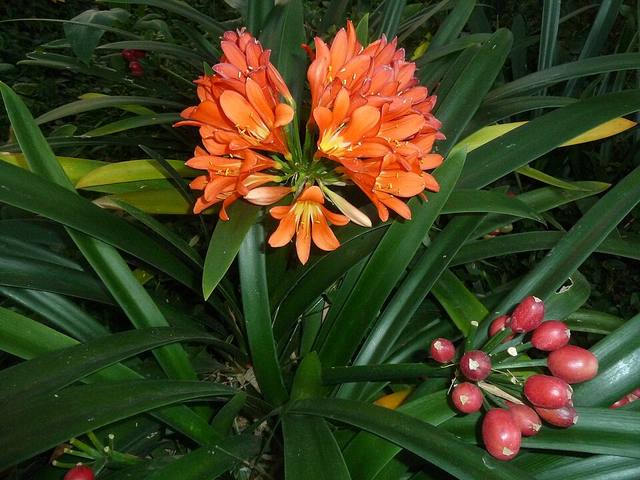
Photo: JMK · CC BY-SA 3.0 · Wikimedia Commons

Bush lily
Clivia miniata
Also called Clivia, Kaffir lily, Natal lily
Houseplant · Family Amaryllidaceae · Native to South Africa (eastern forests)
A tough evergreen with dark, strap-like leaves and clusters of orange trumpet flowers in late winter or spring. It is long-lived and likes being left alone.
Toxic to cats and dogs
Toxic principle: Lycorine and other alkaloids
Signs: Vomiting, salivation, diarrhea; large ingestions cause convulsions, low blood pressure, tremors, cardiac arrhythmias. Bulbs are the most poisonous part
Care
Light
Medium light
Bright shade or filtered light, without direct summer sun, which scorches. Too much shade means no flowers. A cool, bright spot in winter helps it bloom.
Water
About every 14 days in the growing season, every 35 in the cool season
Water thoroughly, then let the soil dry a little. It stores water in thick roots, so it forgives a missed week. Soggy soil rots the roots. Water very little in a cool winter rest.
Water when the top 3 cm (1 in) of soil is dry
Humidity
Low humidity
Ordinary home air is fine.
Temperature
10 to 26 °C (50 to 79 °F)
Grows at 10 to 26 °C (50 to 79 °F). A cool rest at 8 to 12 °C (46 to 54 °F) for 6 to 8 weeks sets buds. Frost kills it; damage starts below about 2 °C (36 °F).
Soil
A loose, rich potting mix with bark or perlite so that water drains fast. Plant with the thick roots just covered and the pot with drainage holes.
Feeding
Every 6 weeks in the growing season
Feed every 6 weeks in spring and summer with a half-strength feed. Stop in autumn and winter.
Repotting
Every 3 years
Repot every 3 to 4 years, only when roots crowd the pot, and right after flowering. It flowers best when snug and resents disturbance.
Pruning
Cut off the flower stalk after the flowers fade, unless you want the red berries. Remove dead leaves at the base.
Propagation
Divide offsets from the base when they have 4 or 5 leaves, after flowering. Seed takes 4 to 6 years to flower.
Size
40 to 70 cm (16 to 28 in)
Slow growing
Outdoors
USDA zones 9 to 11
Grows outdoors in frost-free, shady, humus-rich beds, in 9 to 11. In colder zones, grow it in a pot and keep it indoors in winter.
Common problems
Healthy leaves but no flowers
No cool winter rest, or too much shade
Give it a cool, dry rest at about 10 °C (50 °F) from late autumn for 6 to 8 weeks.
Soft, brown leaf bases
Root rot from overwatering
Cut off rotten roots, repot in dry, loose mix, and water less.
Yellow leaves
Overwatering or too much direct sun
Water only when the top 3 cm (1 in) is dry, and move it out of direct sun.
Brown leaf tips
Dry soil or salt build-up
Water evenly, and flush the pot with plain water now and then.
White cottony fluff between the leaves
Mealybugs
Dab with a cotton bud dipped in rubbing alcohol, and repeat weekly.
Did you know?
A clivia flowers best when it is crowded in its pot and has had a cool winter rest. Some plants are 50 years old and still flowering, often passed down in families.
General care information for a typical plant. Conditions in your home or garden may need a different rhythm.
Not sure what your plant is?
Identify a plant from a photoSee this guide in the appKagn Plants also keeps your own plants with watering reminders, and its plant doctor reads what is wrong with one.
Updated 22 November 2026.