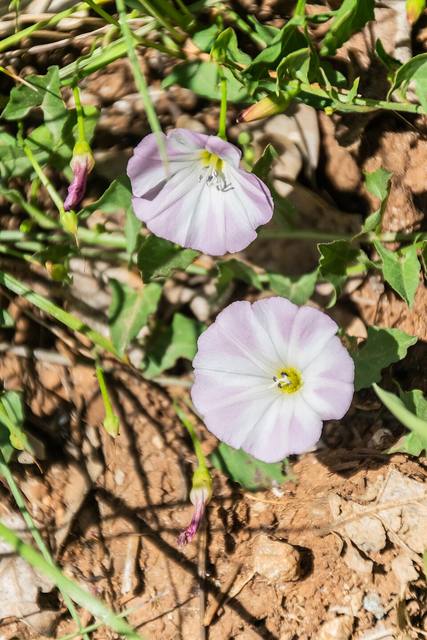
Photo: Krzysztof Golik · CC BY-SA 4.0 · Wikimedia Commons

Field bindweed
Convolvulus arvensis
Also called Creeping jenny (US), Perennial morning glory, Cornbine
Lawn weed · Family Convolvulaceae · Native to Europe and western Asia; weed worldwide
A twining perennial weed with white or pink funnel flowers and arrow-shaped leaves. It smothers lawns, beds and fences and is very hard to remove because its roots run deep.
Not on the ASPCA's list: keep it out of reach of pets.
Care
Light
Full sun
Thrives in full sun on open ground. In shade it grows thin and flowers little, so a dense, shaded planting slows it. It climbs anything it touches.
Water
About every 14 days in the growing season, every 28 in the cool season
It needs no help. Its roots reach 2 m (6 ft) or more, so it lives through drought. Watering a bed does not harm it, but it will also feed the bindweed that is already there.
Not needed: it survives on rain and finds deep water
Humidity
Low humidity
Dry air outdoors is no problem. It does best in hot, dry, open sites.
Temperature
15 to 32 °C (59 to 90 °F)
Grows best at 15 to 32 °C (59 to 90 °F). Tops die back in frost, but roots survive to about -20 °C (-4 °F) and resprout in spring.
Soil
Grows in almost any soil, even poor, dry, compacted or clay ground. Deep roots let it live where lawn grass struggles.
Feeding
Do not feed it. Rich, fertilised soil only helps it spread. Feed the lawn or border plants you want to keep, and keep bare soil covered.
Repotting
Nothing to repot. Every root piece left in the ground can regrow, so never rotovate infested soil.
Pruning
If you want it gone, pull or cut the stems every 1 to 2 weeks so it cannot make leaves and feed the roots. Dig out roots you can reach. Expect to repeat this for 2 to 3 years.
Propagation
It spreads by seed, which stays alive in soil for up to 20 years, and by root fragments. Even a 5 cm (2 in) root piece can grow a new plant, so bag and bin the roots.
Size
20 to 200 cm (8 to 79 in)
Fast growing
Outdoors
USDA zones 3 to 10
Common on farmland, roadsides and gardens in temperate regions. It climbs plants and fences and creeps over lawns. People ask how to remove it, not plant it.
Common problems
White trumpet flowers twining up plants
Field bindweed climbing
Unwind the stems from your plants gently, cut them at the base and dig the root. Do not pull hard, it snaps.
It returns weeks after weeding
Deep roots left in the soil
Cut it back each week so it cannot rebuild. Dig deeper each time you can. A thick mulch or dark sheet over bare soil helps.
Lawn has patches of low arrow leaves
Creeping stems in the grass
Mow often and low so it cannot climb. Then spot-treat or dig the patches.
Plants in the border are strangled
Bindweed twining round stems
Pull the bindweed off the stems early. Do not leave it long or it forms a mat.
Rotovating made it worse
Cut roots each regrew
Do not rotovate or hoe the roots into pieces. Dig out the roots by hand with a fork.
Did you know?
One plant can send roots 3 m (10 ft) or more deep and spread 6 m (20 ft) sideways in a year, and its seeds can stay alive in the soil for decades.
General care information for a typical plant. Conditions in your home or garden may need a different rhythm.
Not sure what your plant is?
Identify a plant from a photoSee this guide in the appKagn Plants also keeps your own plants with watering reminders, and its plant doctor reads what is wrong with one.
Updated 22 November 2026.