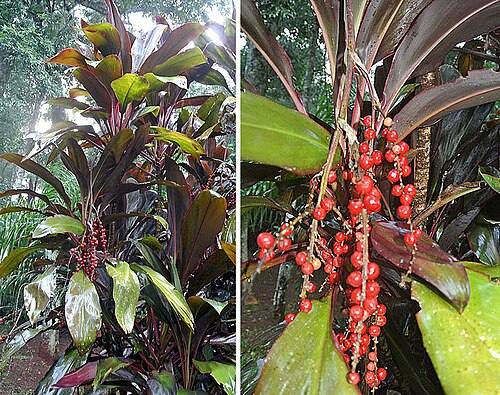
Photo: Dick Culbert from Gibsons, B.C., Canada · CC BY 2.0 · Wikimedia Commons

Ti plant
Cordyline fruticosa
Also called Good luck plant, Hawaiian ti, Cabbage palm
Houseplant · Family Asparagaceae · Native to Southeast Asia, New Guinea and northern Australia
A cane-like plant with a crown of broad, glossy leaves in green, red, pink or purple. It adds tropical colour to a bright room, but it dislikes dry air and cold.
Toxic to cats and dogs
Toxic principle: Saponins
Signs: Vomiting (occasionally with blood), depression, anorexia, hypersalivation, dilated pupils (cats)
Care
Light
Bright, indirect light
Bright, indirect light for the best colour. Colour fades in low light and the leaves become plain green. Hot direct sun scorches the leaves.
Water
About every 7 days in the growing season, every 14 in the cool season
Keep it lightly moist and water thoroughly. It dislikes drying out completely and sitting wet. Brown leaf tips often come from fluoride and salts in tap water.
Water when the top 3 to 5 cm (1 to 2 in) of soil is dry
Humidity
High humidity
It prefers humid air. Dry air gives brown leaf edges and tips. Group it with other plants, or use a pebble tray.
Temperature
18 to 29 °C (64 to 84 °F)
Grows at 18 to 29 °C (64 to 84 °F). Damaged below about 10 °C (50 °F). Keep away from cold draughts.
Soil
A rich, well-draining potting mix with some perlite. The pot needs drainage holes. It prefers a slightly acidic soil.
Feeding
Every 4 weeks in the growing season
Feed every 4 weeks in spring and summer with a half-strength houseplant feed. Skip it in winter.
Repotting
Every 2 years
Repot every 2 years in spring, one size up. A snug pot is fine.
Pruning
Cut off brown leaf tips along the leaf shape and remove old lower leaves. Cut leggy canes back in spring, and they sprout again below the cut.
Propagation
Cut a cane into 10 cm (4 in) pieces, each with a few nodes, and lay them on damp mix, or root a leafy top in water. Rooting takes 4 to 8 weeks.
Size
60 to 150 cm (24 to 59 in)
Medium growth
Outdoors
USDA zones 10 to 12
Grows outdoors in frost-free, humid, part-shaded spots as a foliage shrub. Elsewhere keep it as a houseplant.
Common problems
Brown leaf tips and edges
Fluoride or salts in tap water, or dry air
Use rainwater or filtered water, and raise humidity.
Colours fade to green
Not enough light
Move to brighter indirect light.
Lower leaves yellow and drop
Natural ageing, or overwatering
Remove old leaves. Let the top dry between waterings.
Fine webbing, speckled leaves
Spider mites in dry air
Rinse the leaves, raise humidity and repeat weekly.
Soft, brown stem base
Root rot from cold, wet soil
Cut healthy cane pieces to root and discard the rotten part.
Did you know?
In Polynesia, ti leaves are used for wrapping food, making skirts and roofing. The roots are rich in sugar and have been baked and eaten.
General care information for a typical plant. Conditions in your home or garden may need a different rhythm.
Not sure what your plant is?
Identify a plant from a photoSee this guide in the appKagn Plants also keeps your own plants with watering reminders, and its plant doctor reads what is wrong with one.
Updated 22 November 2026.