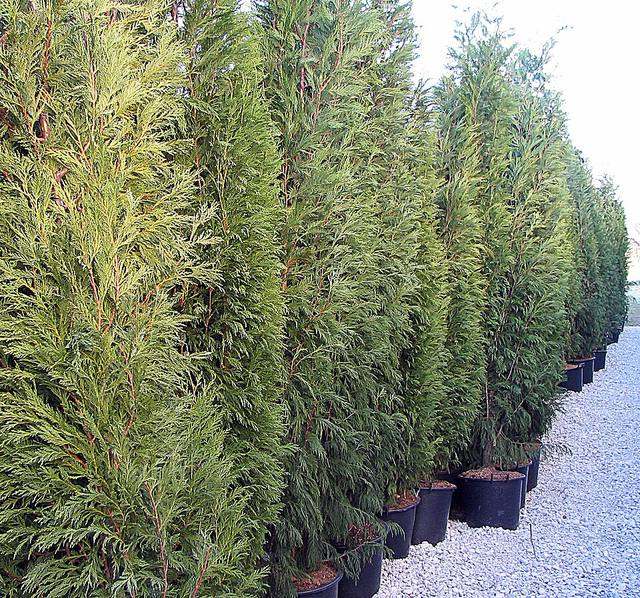
Photo: Gmihail at Serbian Wikipedia · CC BY-SA 3.0 rs · Wikimedia Commons

Leyland cypress
Cupressus leylandii
Also called Leylandii, Leyland
Tree · Family Cupressaceae · Native to Garden hybrid from the Americas (Pacific coast)
A very fast evergreen conifer used for screens and hedges. It can grow 1 m (3 ft) a year but needs trimming at least once a year to stay in bounds.
Not on the ASPCA's list: keep it out of reach of pets.
Care
Light
Full sun
Needs full sun to light shade. It browns inside in deep shade.
Water
About every 7 days in the growing season, every 21 in the cool season
Water new hedges deeply every week for 2 years. Established plants tolerate dry spells but suffer in long drought. Evergreen, so water new plants monthly in a dry winter.
Water new plants every 5 to 7 days in dry weather
Humidity
Medium humidity
Outdoor humidity is no concern. Winter cold with wind browns the foliage.
Temperature
5 to 25 °C (41 to 77 °F)
Hardy to about -23 °C (-10 °F). Grows best at 5 to 25 °C (41 to 77 °F). Cold winds and hard frost burn foliage.
Soil
Fertile, well-drained soil, neutral to slightly acid. It tolerates clay, salt-laden air and poor soil if not waterlogged.
Feeding
Feed hedges once in spring with a balanced slow-release feed. Mulch with compost.
Repotting
Plant in the ground. Not suited to pots long term.
Pruning
Trim 2 or 3 times a year from late spring, cutting only green growth. Do not cut into bare brown wood, since it does not regrow. Keep the bottom wider than the top.
Propagation
Take semi-ripe cuttings in late summer, though most hedge plants are bought as young potted plants.
Size
300 to 3000 cm (118 to 1181 in)
Fast growing
Outdoors
USDA zones 6 to 10
Plant 60 to 90 cm (24 to 36 in) apart for a hedge. It can reach 20 m (65 ft), which blocks light and may cause neighbour disputes. Keep it clipped.
Common problems
Hedge reaches 10 m (33 ft) and shades neighbours
Neglected trimming
Cut back each year while still green. Do not let it pass the height you want.
Brown patches in the hedge
Drought, windburn or cutting into old wood
Water deeply, shelter from wind and do not cut into bare wood.
Tree blown over or leaning
Shallow roots and wind
Stake young trees and keep them trimmed.
Browning from the base
Shade, root rot or cypress canker
Improve drainage, thin neighbours and cut out diseased branches.
Sap irritates skin
Cut foliage
Wear gloves and long sleeves when clipping.
Did you know?
It arose by chance in 1888 at Leighton Hall, Wales, when Monterey cypress and Nootka cypress, native to North America, grew side by side and crossed.
General care information for a typical plant. Conditions in your home or garden may need a different rhythm.
Not sure what your plant is?
Identify a plant from a photoSee this guide in the appKagn Plants also keeps your own plants with watering reminders, and its plant doctor reads what is wrong with one.
Updated 22 November 2026.