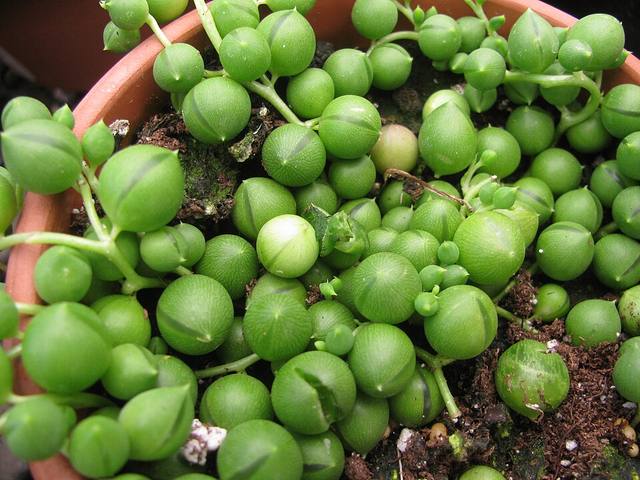
Photo: Flickr user Forest and Kim Starr · CC BY 2.0 · Wikimedia Commons

String of pearls
Curio rowleyanus
Also called String of beads, Rosary vine
Succulent or cactus · Family Asteraceae · Native to Southwest Africa (Namibia, South Africa)
A trailing succulent whose stems are strung with round, pea-like leaves. It is grown in hanging pots, but it is fussier about water than most succulents.
The ASPCA lists a close relative, golden Ragwort (Senecio species), as toxic to cats and dogs: treat this plant the same.
Care
Light
Bright, indirect light
Bright light, with a few hours of gentle sun from an east window. Leaves that flatten or stems that go thin and bare mean too little light; shrivelled pearls mean thirst.
Water
About every 14 days in the growing season, every 30 in the cool season
Water the pot thoroughly, then leave it dry. The shallow roots rot fast in wet soil, so overwatering is the commonest way to lose it. Water a little more in summer, much less in winter.
Water when the pearls feel slightly soft and the top 5 cm (2 in) is dry
Humidity
Low humidity
Dry household air is fine. It does not need misting, which only wets the stems and invites rot.
Temperature
15 to 27 °C (59 to 81 °F)
Best at 15 to 27 °C (59 to 81 °F). It is damaged below about 5 °C (41 °F), and a cool winter rest helps it flower.
Soil
A fast-draining cactus mix with extra perlite or grit, in a shallow pot with drainage holes. Terracotta helps the soil dry quickly.
Feeding
Every 8 weeks in the growing season
Feed with a weak cactus fertiliser about every 8 weeks in spring and summer. Skip it in autumn and winter.
Repotting
Every 2 years
Repot only when the pot is crowded, usually every 2 to 3 years, in spring. Handle gently as the stems snap easily.
Pruning
Trim bare or dead strands to just above a pearl. Cutting long strands also makes the plant bushier at the pot rim.
Propagation
Lay 5 cm (2 in) pieces of stem on gritty, barely damp soil, pressing the pearls in. They root in a few weeks without any water in the pot.
Size
15 to 60 cm (6 to 24 in)
Medium growth
Outdoors
USDA zones 10 to 12
Outdoors only in frost-free climates, in bright shade or morning sun, in a rock garden or pot. Elsewhere keep it indoors.
Common problems
Flat, shrivelled pearls
Thirst
Give a thorough soak, then let it dry. Pearls plump up within days.
Mushy, translucent pearls
Overwatering
Cut away rotten strands, let the soil dry out fully and repot into gritty mix.
Bare stems between pearls
Too little light
Move to a brighter spot and trim the bare lengths.
Pearls turn pale or brown
Strong direct sun
Pull back from hot midday sun; give bright indirect light.
White cottony fluff
Mealybugs
Dab each with rubbing alcohol on a cotton bud and repeat weekly.
Did you know?
Each pearl has a small clear strip, or 'window', that lets light into the leaf. A round shape holds the most water for the least surface, which helps it survive drought.
General care information for a typical plant. Conditions in your home or garden may need a different rhythm.
Not sure what your plant is?
Identify a plant from a photoSee this guide in the appKagn Plants also keeps your own plants with watering reminders, and its plant doctor reads what is wrong with one.
Updated 22 November 2026.