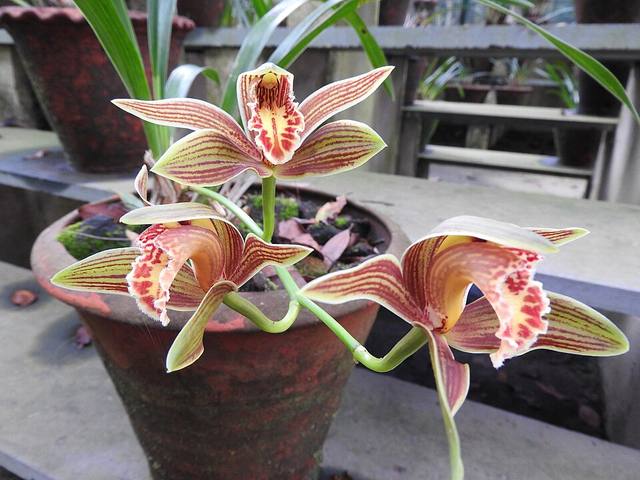
Photo: Yercaud-elango · CC BY-SA 4.0 · Wikimedia Commons

Cymbidium orchid
Cymbidium
Also called Boat orchid, Cymbidium
Houseplant · Family Orchidaceae · Native to Tropical and subtropical Asia, and Australia
A large orchid with long, strap-like leaves and tall spikes of waxy flowers in winter or spring. Most plants sold are hybrids that like cool nights.
Not on the ASPCA's list: keep it out of reach of pets.
Care
Light
Bright, indirect light
Bright light with some direct sun in winter. In summer, give light shade, outdoors if you can. Dark green, floppy leaves mean too little light, and flowers need a bright spot.
Water
About every 7 days in the growing season, every 14 in the cool season
Water thoroughly while it grows and let the mix start to dry before the next. Never leave it standing wet. Water a bit less while the flower spike forms.
Water when the top 2 cm (1 in) of mix is dry
Humidity
Medium humidity
Average humidity is fine. Good air movement matters more.
Temperature
10 to 28 °C (50 to 82 °F)
Most hybrids need cool nights of 10 to 15 °C (50 to 59 °F) in autumn to flower. They tolerate 28 °C (82 °F) in summer. Some tolerate light frost.
Soil
A coarse, free-draining orchid or terrestrial orchid mix with bark and perlite. Use a pot with drainage holes. The thick roots need air.
Feeding
Every 2 weeks in the growing season
Feed every 2 weeks in spring and summer with a balanced fertiliser at half strength. In late summer switch to a high-potassium feed.
Repotting
Every 3 years
Repot every 3 years after flowering, in a pot one size up. Divide a large clump at the same time.
Pruning
Cut off the flower stalk at the base after the flowers fade. Remove dead leaves.
Propagation
Divide the clump after flowering, with at least 3 bulbs (pseudobulbs) per piece, and pot each in coarse orchid mix.
Size
40 to 100 cm (16 to 39 in)
Medium growth
Outdoors
USDA zones 9 to 11
Grows outdoors in mild, frost-free climates in light shade. Elsewhere, put it outside in summer in part shade and bring it in before frost.
Common problems
Leaves but no flowers
Warm nights or too little light
Give it cool autumn nights of 10 to 15 °C (50 to 59 °F) and brighter light.
Bud drop
Sudden change, cold draft or dry roots
Keep the plant in the same place once buds form, and water evenly.
Yellow leaves
Overwatering or old leaves
Water less and remove the oldest leaves.
Brown spots on leaves
Sunburn or fungal spot
Provide light shade in summer, and keep leaves dry.
Silvery streaks on leaves
Spider mites or thrips
Rinse the leaves and check the undersides.
Did you know?
Cymbidium flowers can last up to 8 to 12 weeks on the plant, making it one of the longest-lasting orchid blooms.
General care information for a typical plant. Conditions in your home or garden may need a different rhythm.
Not sure what your plant is?
Identify a plant from a photoSee this guide in the appKagn Plants also keeps your own plants with watering reminders, and its plant doctor reads what is wrong with one.
Updated 22 November 2026.