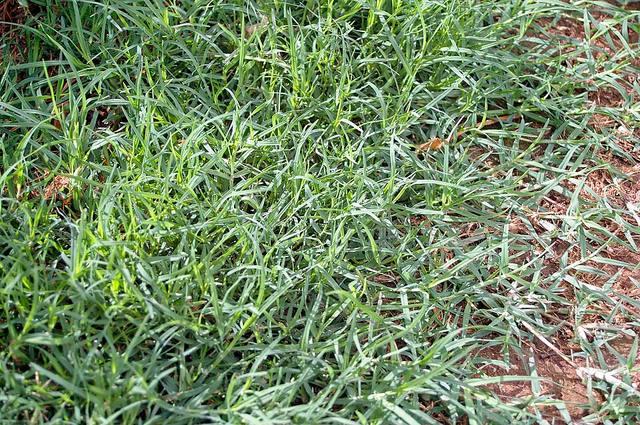
Photo: Bidgee · CC BY-SA 3.0 · Wikimedia Commons

Bermuda grass
Cynodon dactylon
Also called Couch grass, Devil's grass, Wire grass
Lawn weed · Family Poaceae · Native to Africa, Asia and Australia, now worldwide
A tough, fine-leaved creeping grass that spreads by runners above and below ground. It is prized as a hard-wearing lawn in warm regions and cursed as a weed in flower beds and cool-season lawns.
Not on the ASPCA's list: keep it out of reach of pets.
Care
Light
Full sun
It needs full sun and fades in shade. Thin, weak growth under trees or a building means it is losing, which is the easiest way to shrink it in a lawn you want to keep for other grasses.
Water
About every 7 days in the growing season, every 21 in the cool season
Deep, infrequent watering suits it. It survives drought by going brown and dormant, then recovers. In winter cold it goes brown and dormant. That is normal, not a sign it has died.
Water when the grass turns grey-green and footprints stay flat
Humidity
Low humidity
Dry air does not bother it. It copes with hot, dry summers better than most lawn grasses.
Temperature
24 to 38 °C (75 to 100 °F)
Grows best at 24 to 38 °C (75 to 100 °F) and stops below about 15 °C (59 °F). Frost browns the leaves. The roots survive to about -10 °C (14 °F).
Soil
Grows in almost any soil, even poor, sandy or compacted ground, from pH 5.5 to 7.5. It does best in fertile, free-draining soil.
Feeding
Every 6 weeks in the growing season
Only if you are keeping it as a lawn: feed every 6 weeks in summer. If you want it gone, do not feed it.
Repotting
Not potted. If you want to keep it, mow it low and let it knit together. To remove it, dig out the runners and roots.
Pruning
Mow to 2 to 4 cm (1 to 1.5 in) as a lawn. To remove it from beds, dig out every runner and root piece, because any bit left regrows.
Propagation
It spreads by itself. A turf plug or a piece of runner with a node, pressed into bare soil in summer, roots within weeks.
Size
5 to 30 cm (2 to 12 in)
Fast growing
Outdoors
USDA zones 7 to 11
It grows in full sun on lawns, sports pitches and verges in warm climates. It is invasive in beds and cool-season lawns, where it spreads in summer.
Common problems
Green runners crossing a flower bed or path
Creeping stems rooting at every node
Pull the runners up by hand and follow them back to the source. Dig out the whole mat, or smother it under thick card and mulch for a season.
It comes back after you dig it
Small pieces of root and runner left in the soil
Sift the soil and remove all pieces. Check the bed every two weeks in summer and pull new shoots while they are small.
Brown, dead-looking patches in winter
Normal cold dormancy
This is not damage. It greens up again when the soil warms in spring.
It invades a cool-season lawn in summer
It thrives in heat and thins out cool-season grasses
Keep the lawn thick and cut high, and feed it in autumn. Dig out the patches in spring before they join.
Weedkiller kills the desired grass too
A spray that kills any grass kills every grass it touches
Use a shield or paint it onto the leaves of the weed only, or dig. Check the label for lawn use.
Did you know?
It spreads by two kinds of runner, one above ground and one below. A single plug of it can cover a large area in a warm season, which is why it is both a famous lawn grass and a famous weed.
General care information for a typical plant. Conditions in your home or garden may need a different rhythm.
Not sure what your plant is?
Identify a plant from a photoSee this guide in the appKagn Plants also keeps your own plants with watering reminders, and its plant doctor reads what is wrong with one.
Updated 22 November 2026.