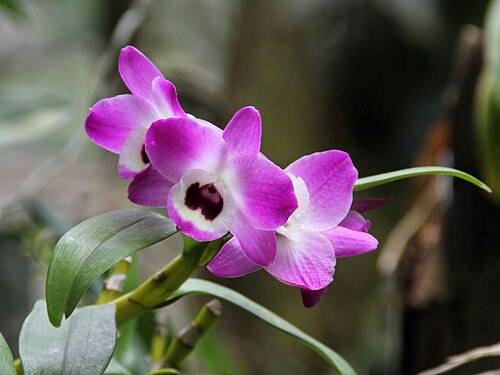
Photo: Fan Wen · CC BY-SA 4.0 · Wikimedia Commons

Noble dendrobium
Dendrobium nobile
Also called Noble orchid, Dendrobium
Houseplant · Family Orchidaceae · Native to Himalayas to southern China and Southeast Asia
An orchid with upright, cane-like stems that carry clusters of white and pink flowers along the length of the cane in spring. It needs a winter rest to flower.
Not on the ASPCA's list: keep it out of reach of pets.
Care
Light
Bright, indirect light
Bright light with some direct morning sun, and a lot of light in winter. Without enough light it makes leaves but no flowers. Hot midday sun burns the leaves.
Water
About every 5 days in the growing season, every 21 in the cool season
Water well in the growing season and let the mix dry between waterings. After the canes mature in autumn, water very little in winter until buds form.
Water when the mix is dry
Humidity
Medium humidity
Average humidity is fine. Good air movement helps.
Temperature
10 to 28 °C (50 to 82 °F)
Grow it at 18 to 28 °C (64 to 82 °F) in summer. In winter a cool rest at 10 to 15 °C (50 to 59 °F) helps buds form. It is damaged below about 5 °C (41 °F).
Soil
A very open mix of bark and perlite or sphagnum moss in a small pot, or mounted on bark. Water must drain through at once.
Feeding
Every 2 weeks in the growing season
Feed every 2 weeks in spring and summer with a half-strength feed. Stop in autumn to let the canes ripen.
Repotting
Every 3 years
Repot every 3 years after flowering, only when the pot is full. It flowers best with roots snug.
Pruning
Do not cut canes: old leafless canes still flower. Remove only dead, shrivelled canes.
Propagation
Cut off keikis (baby plants) that form on the canes once they have roots 3 to 5 cm (1 to 2 in) long and pot them in orchid mix.
Size
30 to 60 cm (12 to 24 in)
Slow growing
Outdoors
USDA zones 9 to 11
Grows outdoors in frost-free gardens in light shade, on trees or in pots. Elsewhere, it is a houseplant that can summer outdoors.
Common problems
No flowers
No cool, dry winter rest
Give it cooler nights and almost no water in winter.
Baby plants on canes instead of flowers
Too warm or too wet in winter
Keep it cooler and drier in winter.
Wrinkled canes
Underwatering or root loss
Check roots, repot if rotten and water more carefully.
Yellow leaves in autumn
Natural leaf drop
This is normal as it rests. Do not water more.
Brown spots on leaves
Sunburn or fungal spot
Provide morning sun only and keep leaves dry.
Did you know?
Each cane lives for several years, and flowers appear along the whole length of leafless canes that are two or more years old.
General care information for a typical plant. Conditions in your home or garden may need a different rhythm.
Not sure what your plant is?
Identify a plant from a photoSee this guide in the appKagn Plants also keeps your own plants with watering reminders, and its plant doctor reads what is wrong with one.
Updated 22 November 2026.