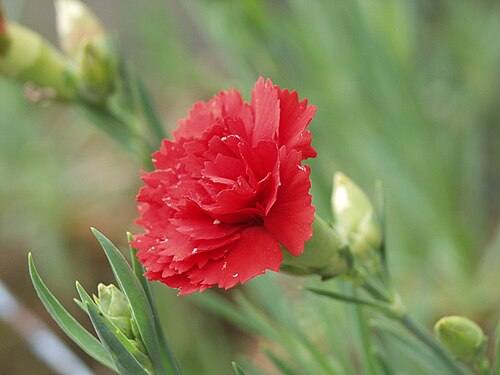
Photo: 草花写真館 · CC BY-SA 3.0 · Wikimedia Commons

Carnation
Dianthus caryophyllus
Also called Clove pink, Border carnation, Pinks
Garden flower · Family Caryophyllaceae · Native to Mediterranean region
A clove-scented flower with frilly petals, grown for cutting and for border edges. Florists use it for buttonholes and bouquets, and cut stems last a week or two.
Toxic to cats and dogs
Toxic principle: Unknown irritant
Signs: Mild gastrointestinal signs, mild dermatitis
Care
Light
Full sun
Full sun, with at least 6 hours. In shade stems are weak and flowers few.
Water
About every 7 days in the growing season, every 14 in the cool season
Water at the base once a week in dry weather. It dislikes wet soil, and leaves held wet in humid weather bring mould. Water pots less in winter.
Water when the top 3 to 5 cm (1 to 2 in) of soil is dry
Humidity
Low humidity
Prefers dry air. In still, humid air it gets fungal disease.
Temperature
10 to 24 °C (50 to 75 °F)
Best at 10 to 24 °C (50 to 75 °F). Hardy to about -12 °C (10 °F) if soil drains.
Soil
Well-drained, neutral to slightly alkaline soil. Add grit to heavy soil. It dislikes acid, wet ground.
Feeding
Every 4 weeks in the growing season
Feed every 4 weeks in the growing season with a high-potash feed. Too much nitrogen gives soft leaves.
Repotting
Every 3 years
Plants are short-lived. Replace or take cuttings every 3 years. In pots, repot in spring.
Pruning
Pinch out the tips of young plants to make them bushy. Remove faded flowers. Stake tall border types. For big cut flowers, remove side buds.
Propagation
Take 8 cm (3 in) cuttings of non-flowering shoots in summer and root them in gritty mix. They root in 3 weeks. Layering also works.
Size
30 to 90 cm (12 to 35 in)
Medium growth
Outdoors
USDA zones 6 to 9
A perennial in zones 6 to 9. Plant 25 to 30 cm (10 to 12 in) apart in a sunny, well-drained border or a pot.
Common problems
Yellow, dying plants
Wet soil and root rot
Plant in gritty, free-draining soil and water at the base.
Grey mould on leaves and buds
Botrytis in damp air
Remove affected parts and give more space and air.
Stems bend or fall
Weak stems
Stake early and grow in full sun.
Calyx splits on the bud
Uneven watering or temperature
Water evenly. Some types split naturally. Pick them young.
Greyish, stunted, rust-spotted leaves
Rust or mite
Remove affected leaves and bin them.
Did you know?
The flower's colour name, carnation, comes from the word for flesh, and its scent of cloves made it a favourite for flavouring wine.
General care information for a typical plant. Conditions in your home or garden may need a different rhythm.
Not sure what your plant is?
Identify a plant from a photoSee this guide in the appKagn Plants also keeps your own plants with watering reminders, and its plant doctor reads what is wrong with one.
Updated 22 November 2026.