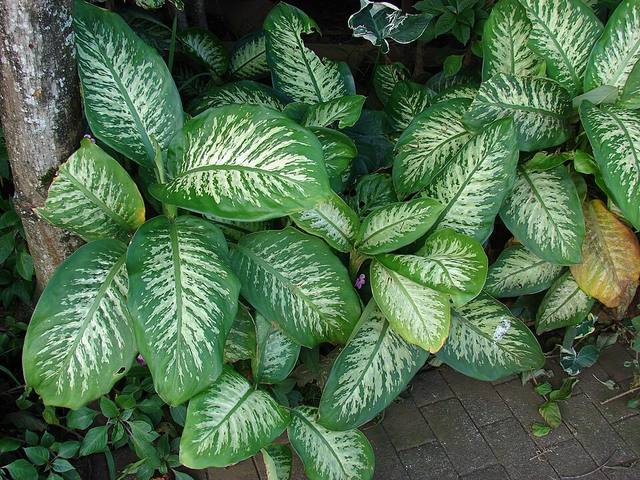
Photo: Forest & Kim Starr · CC BY 3.0 · Wikimedia Commons

Dumb cane
Dieffenbachia seguine
Also called Dieffenbachia, Leopard lily, Tropic snow
Houseplant · Family Araceae · Native to Caribbean, Central America and tropical South America
A bold plant with big, cream-splashed leaves on thick stems. It is easy and fast, but all parts are irritating to mouths, so keep it away from pets and children.
Toxic to cats and dogs
Toxic principle: Insoluble calcium oxalates, proteolytic enzyme
Signs: Oral irritation, intense burning of mouth, tongue and lips, drooling, vomiting, difficulty swallowing
Care
Light
Medium light
Bright indirect light. Direct sun scorches leaves. In low light it grows tall and bare, and the patterns fade.
Water
About every 7 days in the growing season, every 12 in the cool season
Water well, then let the top dry. It dislikes soggy soil, which brings yellow leaves and a rotting stem. Cold water also upsets it.
Water when the top 3 to 5 cm (1 to 2 in) of soil is dry
Humidity
Medium humidity
Does well in normal home air. Brown leaf tips and edges show dry air or cold draughts.
Temperature
18 to 29 °C (64 to 84 °F)
Keep at 18 to 29 °C (64 to 84 °F). Damaged below about 12 °C (54 °F), and it hates cold draughts.
Soil
Rich, well-draining potting mix with extra perlite. The pot needs drainage holes.
Feeding
Every 4 weeks in the growing season
Feed every 4 weeks in spring and summer with a diluted houseplant fertiliser. Skip it in winter.
Repotting
Every 2 years
Repot every 2 years in spring, one size up. Wear gloves, because the sap irritates skin.
Pruning
Cut a leggy stem back to 15 cm (6 in) in spring to make it branch. Wear gloves and wash your hands, because the sap irritates skin and eyes.
Propagation
Cut a stem into 8 to 10 cm (3 to 4 in) pieces, each with a node, and lay them on damp mix, or root the leafy top in water. Wear gloves.
Size
60 to 150 cm (24 to 59 in)
Fast growing
Outdoors
USDA zones 10 to 12
Grows outdoors in frost-free, humid shade. Elsewhere keep it as a houseplant.
Common problems
Yellow lower leaves
Overwatering or age
Let the top dry between waterings. Remove old leaves; a few lost over time is normal.
Brown leaf edges
Dry air, cold draughts or salt build-up
Move away from vents and flush the soil with plain water now and then.
Tall, bare stem
Low light
Cut back in spring and move to brighter indirect light.
Soft, mushy stem base
Stem rot from cold, wet soil
Take healthy tip cuttings, discard the rotten part and repot in dry mix.
Faded, plain leaves
Not enough light
Move it to a brighter spot out of direct sun.
Did you know?
The common name comes from the swollen mouth and tongue that chewing a leaf causes, which can make speech difficult for a time.
General care information for a typical plant. Conditions in your home or garden may need a different rhythm.
Not sure what your plant is?
Identify a plant from a photoSee this guide in the appKagn Plants also keeps your own plants with watering reminders, and its plant doctor reads what is wrong with one.
Updated 22 November 2026.