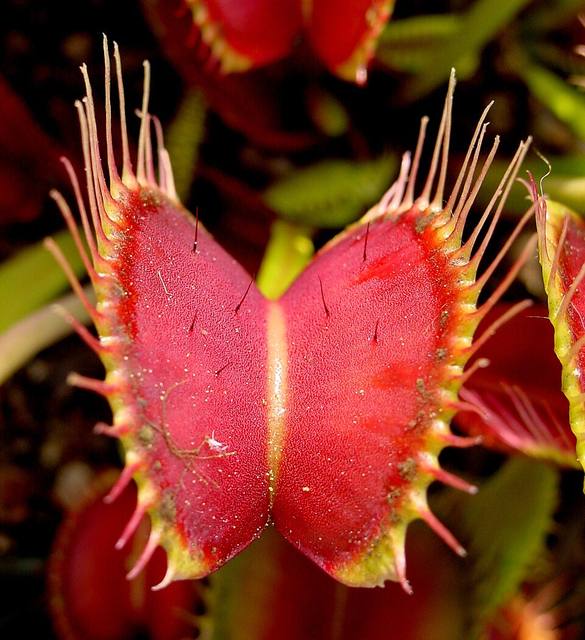
Photo: Noah Elhardt · CC BY-SA 2.5 · Wikimedia Commons

Venus flytrap
Dionaea muscipula
Also called Venus fly trap
Houseplant · Family Droseraceae · Native to Coastal bogs of North and South Carolina, USA
A carnivorous plant whose hinged leaf tips snap shut on insects. It is grown as a curiosity, but it has strict needs: pure water, strong light and a winter rest.
The ASPCA lists this plant as non-toxic to cats and dogs
Care
Light
Full sun
Needs at least 4 to 6 hours of direct sun, such as a south window or outdoors. Pale, floppy leaves and traps that stay green mean too little light.
Water
About every 3 days in the growing season, every 10 in the cool season
Use only rainwater, distilled or reverse-osmosis water. Tap water minerals slowly kill it. In winter, keep it just damp, not standing in water.
Keep the soil constantly damp; stand the pot in 1 to 2 cm (0.5 in) of water in summer
Humidity
Medium humidity
Normal room air is fine, with no extra misting. It does not need a closed terrarium.
Temperature
10 to 30 °C (50 to 86 °F)
Needs a cool winter rest of 0 to 10 °C (32 to 50 °F) for 3 to 4 months. In summer 20 to 30 °C (68 to 86 °F). Hard frost below about -5 °C (23 °F) can kill it.
Soil
A mix of peat or coir and perlite or silica sand, 1:1, with no fertiliser or compost. Garden soil and normal potting mix will kill it.
Feeding
Do not feed it. It catches its own insects, and fertiliser burns the roots. If it has no insects, feed one small insect to one trap now and then.
Repotting
Every 2 years
Repot every 1 to 2 years in early spring into a pot 15 cm (6 in) deep, in fresh peat and perlite.
Pruning
Cut off black traps and the flower stalk in spring. Do not cut off a trap that is still partly green.
Propagation
Divide clumps at repotting. Pull off a leaf with its white base and set it on wet peat for a new plant, which takes months.
Size
10 to 25 cm (4 to 10 in)
Slow growing
Outdoors
USDA zones 7 to 10
Hardy in mild, wet climates in an acid bog with full sun. Elsewhere it is an indoor or patio plant, with a winter rest outside the heat.
Common problems
Traps turn black
Natural ageing, or tap water, or a trap touched too much
Cut black traps off. Switch to rainwater and avoid triggering traps.
No new growth, dull plant
No winter rest
Give 3 to 4 months of cool dormancy at 0 to 10 °C (32 to 50 °F).
Leaves floppy, traps do not close
Not enough light
Move to full sun, outdoors in summer.
Black tips and a crusty pot
Mineral build-up from tap water
Flush with rainwater and repot into fresh peat.
Plant grows pale and weak
Too little water or feeding
Keep the tray topped up with rainwater and never fertilise.
Did you know?
A trap shuts only if two trigger hairs are touched within about 20 seconds, so the plant spends energy only on real prey. A closed trap can take around a week to digest an insect.
General care information for a typical plant. Conditions in your home or garden may need a different rhythm.
Not sure what your plant is?
Identify a plant from a photoSee this guide in the appKagn Plants also keeps your own plants with watering reminders, and its plant doctor reads what is wrong with one.
Updated 22 November 2026.