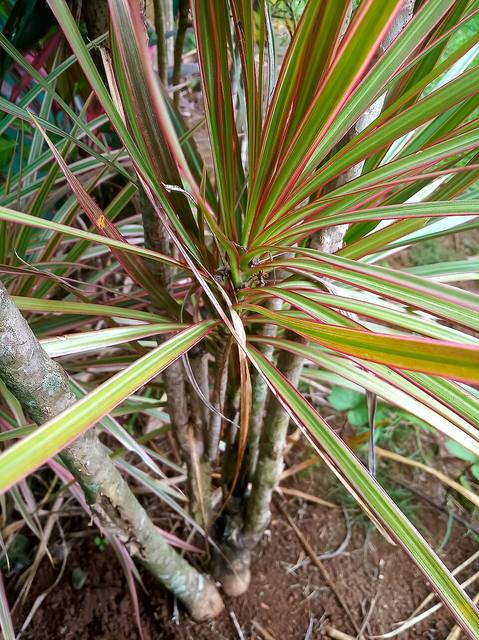
Photo: Filo gèn' · CC BY-SA 4.0 · Wikimedia Commons

Dragon tree
Dracaena marginata
Also called Madagascar dragon tree, Red-edged dracaena
Houseplant · Family Asparagaceae · Native to Madagascar
A tall, slim plant with a bare stem and tufts of narrow, red-edged leaves. It is a tough, long-lived houseplant for offices and hallways.
Toxic to cats and dogs
Toxic principle: Unknown
Signs: In cats: dilated pupils, abdominal pain, increased heart rate, drooling. In cats and dogs: vomiting, depression, loss of appetite, drooling, weakness
Care
Light
Medium light
Medium to bright indirect light; it tolerates lower light but grows slowly. Direct summer sun scorches the leaves, and the red colour fades in poor light.
Water
About every 10 days in the growing season, every 21 in the cool season
Water thoroughly, then let the top soil dry out. It is drought-tolerant and hates wet roots, so overwatering is the commonest problem. Use water low in fluoride if tips brown.
Water when the top 5 cm (2 in) of soil is dry
Humidity
Low humidity
Normal home air is fine. Dry air and fluoride in tap water often brown the leaf tips.
Temperature
16 to 28 °C (61 to 82 °F)
Best at 16 to 28 °C (61 to 82 °F). It is damaged below about 10 °C (50 °F) and drops leaves in cold draughts.
Soil
A well-draining potting mix with some perlite or sand. It needs a heavy pot with drainage holes, as it can get top-heavy.
Feeding
Every 8 weeks in the growing season
Feed with a half-strength houseplant fertiliser every 6 to 8 weeks in spring and summer. None in winter.
Repotting
Every 3 years
It likes being slightly pot-bound. Repot every 2 to 3 years in spring into a pot only a little larger.
Pruning
Cut a tall stem back in spring; new leaf tufts sprout below the cut. Remove the lowest dead leaves by hand.
Propagation
Cut a 15 cm (6 in) piece of stem or the top, with leaves, in spring. Stand it in water or damp mix; roots form in 4 to 8 weeks.
Size
100 to 300 cm (39 to 118 in)
Slow growing
Outdoors
USDA zones 10 to 12
Frost-free climates, in sun or part shade in well-drained soil. Elsewhere grow in a pot indoors and take it out in summer.
Common problems
Brown leaf tips
Fluoride in water, dry air or uneven watering
Use rainwater or filtered water and water more evenly; trim the tips.
Yellow lower leaves
Overwatering or normal ageing
Let the top dry between waterings; a few old leaves drop naturally.
Soft, wrinkled stem
Root rot
Cut healthy stem above the rot, root it, and discard the wet soil.
Pale, scorched leaf patches
Direct sun
Move out of strong direct sun.
Red edge fades, growth is thin
Not enough light
Move to a brighter spot.
Did you know?
Its new leaves form in tufts at the stem tip, so the bare, bendy trunk grows slowly and often curves toward the light. Indoors it can live for decades.
General care information for a typical plant. Conditions in your home or garden may need a different rhythm.
Not sure what your plant is?
Identify a plant from a photoSee this guide in the appKagn Plants also keeps your own plants with watering reminders, and its plant doctor reads what is wrong with one.
Updated 22 November 2026.