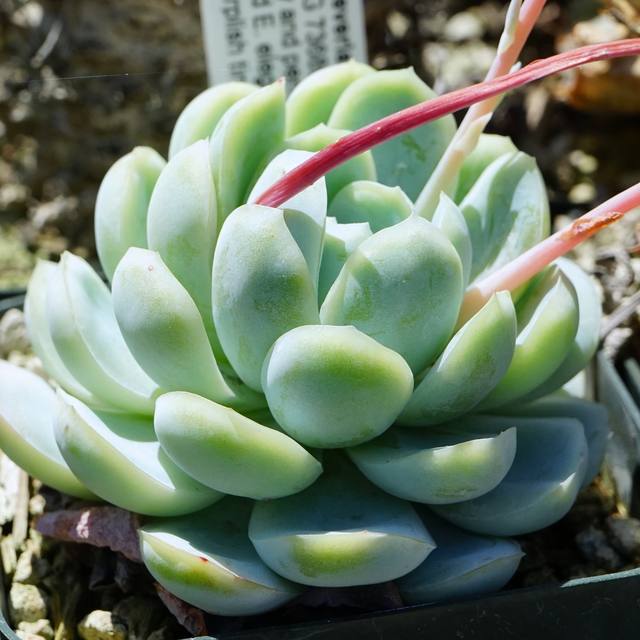
Photo: EriaWei · CC BY-SA 4.0 · Wikimedia Commons

Mexican snowball
Echeveria elegans
Also called Mexican gem, White Mexican rose, Hen and chicks
Succulent or cactus · Family Crassulaceae · Native to Northeastern Mexico
A tidy, pale blue-green rosette succulent that forms clumps of offsets. Many hybrids are sold under the same care, and it is popular in pots and rock gardens.
Not on the ASPCA's list: keep it out of reach of pets.
Care
Light
Full sun
Bright light with several hours of direct sun. Stretched, pale growth (etiolation) means not enough light; sudden strong sun can scorch.
Water
About every 14 days in the growing season, every 35 in the cool season
Water the soil, not the rosette, and let it dry out fully. Water trapped in the leaves causes rot. Soft, translucent leaves mean too much water.
Water when the soil is dry all the way down
Humidity
Low humidity
Dry air suits it. Humid, still air invites rot and mealybugs.
Temperature
10 to 27 °C (50 to 81 °F)
Best at 10 to 27 °C (50 to 81 °F). A cool, dry winter helps flowers. Below 5 °C (41 °F) leaves are damaged.
Soil
Gritty cactus mix, with extra pumice or grit. Use a shallow pot with a drainage hole.
Feeding
Every 8 weeks in the growing season
Feed 2 or 3 times in spring and summer with a half-strength cactus fertiliser. None in winter.
Repotting
Every 2 years
Repot every 2 years in spring or when offsets crowd the pot, into a shallow pot.
Pruning
Remove dead lower leaves by hand. Cut off flower stems after blooming.
Propagation
Twist off a healthy leaf, let the end dry for 2 to 3 days, then lay it on dry mix; roots and a tiny plant form in weeks. Or separate offsets.
Size
10 to 20 cm (4 to 8 in)
Slow growing
Outdoors
USDA zones 9 to 11
Outdoors in frost-free climates in full sun, with sharp drainage, in rock gardens and containers.
Common problems
Stretched, pale rosette
Not enough light
Move to full sun and acclimatise slowly.
Soft, translucent leaves
Overwatering
Let it dry out; check for root rot.
Black, mushy centre
Water in the rosette or rot
Water the soil only; remove rotted leaves.
Wrinkled, thin leaves
Underwatering
Water deeply.
White cottony spots
Mealybugs
Dab with rubbing alcohol on a cotton bud.
Did you know?
Echeverias are named for the 18th-century Mexican botanical artist Atanasio Echeverría, who drew plants for early expeditions in Mexico.
General care information for a typical plant. Conditions in your home or garden may need a different rhythm.
Not sure what your plant is?
Identify a plant from a photoSee this guide in the appKagn Plants also keeps your own plants with watering reminders, and its plant doctor reads what is wrong with one.
Updated 22 November 2026.