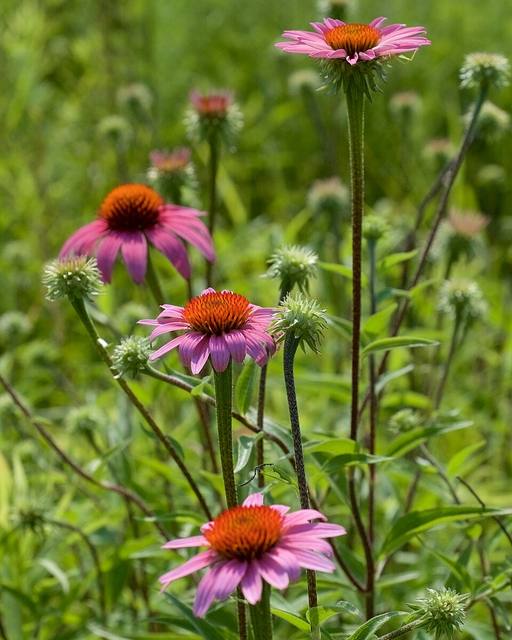
Photo: Eric Hunt · CC BY-SA 4.0 · Wikimedia Commons

Purple coneflower
Echinacea purpurea
Also called Eastern purple coneflower, Echinacea, Coneflower
Garden flower · Family Asteraceae · Native to Central and eastern North America
A tough prairie perennial with large pink-purple flowers and an orange-brown central cone. It blooms from midsummer to autumn and bees and butterflies visit it.
Not on the ASPCA's list: keep it out of reach of pets.
Care
Light
Full sun
Needs full sun, at least 6 hours. In shade it flops and flowers less.
Water
About every 10 days in the growing season, every 30 in the cool season
Established plants rarely need water outside a long dry spell. Water new plants weekly in their first summer. Wet soil in winter is the commonest cause of loss.
Water when the top 5 cm (2 in) of soil is dry
Humidity
Low humidity
Dry air and heat are fine. Give space to avoid mildew.
Temperature
15 to 28 °C (59 to 82 °F)
Hardy to about -34 °C (-29 °F). It grows best at 15 to 28 °C (59 to 82 °F) and handles heat well.
Soil
Average, well-drained soil in full sun. It copes with poor and clay soils, but not constantly wet ones. Neutral pH suits it.
Feeding
Does not need feed. Rich soil gives leafy, floppy plants.
Repotting
Every 4 years
Divide every 4 years in spring or autumn when the centre of the clump dies out or flowers get small.
Pruning
Cut off faded flowers for more blooms, or leave the last ones for birds. Cut stems to the ground in late winter. Pinch stems in early summer to make them stockier.
Propagation
Divide clumps in spring or autumn. Take root cuttings in winter. Seed needs cold first, so sow it outdoors in autumn. Plants flower in the second year.
Size
60 to 120 cm (24 to 47 in)
Medium growth
Outdoors
USDA zones 3 to 9
Plant in sun, 45 cm (18 in) apart. Leave a clump in place for years. Dry seed heads feed finches in winter.
Common problems
Few flowers, floppy stems
Shade or too rich soil
Move to full sun and do not feed.
Plant vanishes after winter
Wet soil rot
Plant in well-drained ground, or raised beds. Mulch lightly.
White powder on leaves
Powdery mildew in humid late summer
Give more space and cut back affected stems.
Petals chewed or deformed
Japanese beetles or aster yellows
Hand-pick beetles. Dig up and bin plants with twisted green flowers.
Hard to tell from other coneflowers
Many cultivars
Purple coneflower has drooping pink petals and a coppery cone.
Did you know?
The genus name comes from the Greek echinos, hedgehog or sea urchin, for the spiny, domed centre of the flower.
General care information for a typical plant. Conditions in your home or garden may need a different rhythm.
Not sure what your plant is?
Identify a plant from a photoSee this guide in the appKagn Plants also keeps your own plants with watering reminders, and its plant doctor reads what is wrong with one.
Updated 22 November 2026.