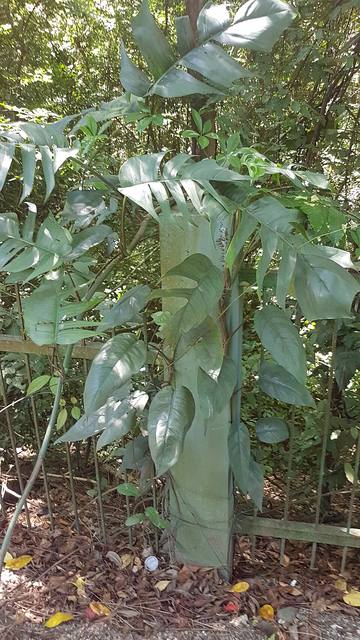
Photo: Obsidian Soul · CC0 · Wikimedia Commons

Dragon tail
Epipremnum pinnatum
Also called Cebu blue pothos, Centipede tongavine, Dragon-tail plant
Houseplant · Family Araceae · Native to Southeast Asia, northern Australia and Pacific islands
A climbing aroid with long, slim leaves that develop splits as they mature. The Cebu blue form has silvery blue-green young leaves. It is easy and grows quickly.
The ASPCA lists a close relative, devils Ivy (Epipremnum aureum), as toxic to cats and dogs: treat this plant the same.
Care
Light
Bright, indirect light
Bright light without hot sun gives the best colour and leaf size. It tolerates medium light but grows slowly and leggy. Direct sun scorches the blue leaves.
Water
About every 7 days in the growing season, every 14 in the cool season
Water well, then let the top dry. It wilts when dry and recovers. Soggy soil causes yellow leaves and root rot. Water about every 2 weeks in winter.
Water when the top 3 to 5 cm (1 to 2 in) of soil is dry
Humidity
Medium humidity
Normal home humidity is fine, though higher humidity gives bigger leaves.
Temperature
18 to 29 °C (64 to 84 °F)
Grows best at 18 to 29 °C (64 to 84 °F). Cold below 12 °C (54 °F) damages leaves.
Soil
A chunky, free-draining mix with bark and perlite. It is a climber and grows well with a moss pole.
Feeding
Every 4 weeks in the growing season
Feed every 4 weeks in spring and summer with a balanced liquid feed. Skip winter.
Repotting
Every 2 years
Repot every 2 years in spring, one pot size up.
Pruning
Trim long stems back in spring to make it bushy. Cut just above a leaf joint. Wear gloves because the sap can irritate skin.
Propagation
Cut a stem piece with a node and a leaf, and root it in water or moist perlite. Roots appear in 2 to 4 weeks.
Size
100 to 300 cm (39 to 118 in)
Fast growing
Outdoors
USDA zones 10 to 12
Frost-free climates only, where it climbs trees in part shade. In cooler climates it is a houseplant.
Common problems
Leaves turn yellow
Overwatering
Let the top 3 to 5 cm (1 to 2 in) dry before watering and check the drainage.
Silvery blue colour fades to green
Low light
Move it brighter, out of direct sun.
Leggy growth, small leaves
Not enough light, no support
Give it a moss pole and brighter light.
Brown leaf tips
Dry air or too little water
Water more evenly and raise humidity.
Cottony fluff on stems
Mealybugs
Dab with alcohol on a cotton bud and repeat weekly.
Did you know?
The Cebu blue form is named after the Philippine island of Cebu, and its silver-blue leaves are the juvenile form: they turn green and split as they climb.
General care information for a typical plant. Conditions in your home or garden may need a different rhythm.
Not sure what your plant is?
Identify a plant from a photoSee this guide in the appKagn Plants also keeps your own plants with watering reminders, and its plant doctor reads what is wrong with one.
Updated 22 November 2026.