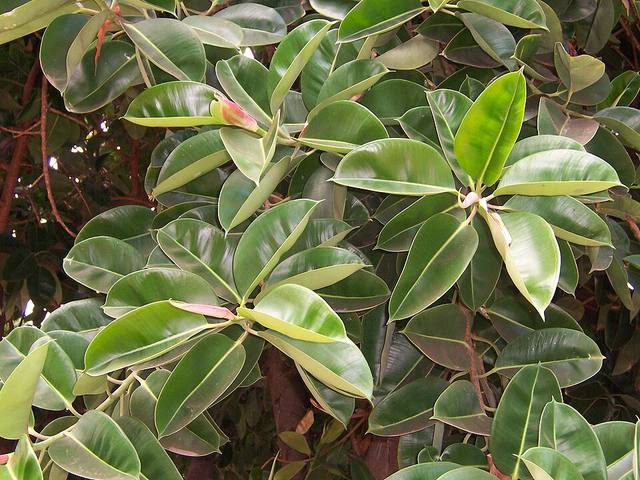
Photo: B.navez · CC BY-SA 3.0 · Wikimedia Commons

Rubber plant
Ficus elastica
Also called Rubber tree, Indian rubber plant, India rubber fig
Houseplant · Family Moraceae · Native to Northeast India to Indonesia
A bold tree with large, thick, glossy leaves. It is tougher than a fiddle-leaf fig and grows well in a bright room.
The ASPCA lists a close relative, fig (Ficus benjamina), as toxic to cats and dogs: treat this plant the same.
Care
Light
Bright, indirect light
Bright indirect light; a little morning sun is fine. Leggy growth and lower leaf drop mean too little light. Red-leaved forms need more light.
Water
About every 10 days in the growing season, every 21 in the cool season
Water well and drain. Dropped lower leaves are usually from too much water or too little light. Wipe dust off the leaves.
Water when the top 5 cm (2 in) of soil is dry
Humidity
Medium humidity
Average home humidity is fine. Avoid heaters and cold draughts.
Temperature
16 to 28 °C (61 to 82 °F)
Best at 16 to 28 °C (61 to 82 °F). Below 10 °C (50 °F) leaves drop.
Soil
Well-draining potting mix with some bark or perlite. A drainage hole is a must.
Feeding
Every 4 weeks in the growing season
Feed every 4 weeks in spring and summer with a balanced liquid fertiliser. None in winter.
Repotting
Every 2 years
Repot every 2 years in spring. It tolerates being a little snug.
Pruning
Cut above a node in spring to control height or make it branch. Milky sap oozes out and irritates skin; wipe it up.
Propagation
Air layering works best. Stem cuttings with a leaf can root, but keep them warm and use a rooting aid if you can.
Size
100 to 250 cm (39 to 98 in)
Medium growth
Outdoors
USDA zones 10 to 12
Outdoors only in frost-free climates, in part shade. In the tropics it becomes a very large tree.
Common problems
Dropping lower leaves
Overwatering, cold or low light
Let the soil dry, keep it warm and give more light.
Brown, crispy edges
Dry soil or dry air
Water more regularly and keep away from heaters.
Leaning or leggy growth
Not enough light
Move to a brighter place and rotate it.
Dusty, dull leaves
Dust on the leaves
Wipe the leaves with a damp cloth.
Tiny webs under leaves
Spider mites
Wipe leaves and spray with insecticidal soap; repeat.
Did you know?
In India, bridges of living root, made by training its aerial roots, can last for hundreds of years. The latex was once used to make rubber.
General care information for a typical plant. Conditions in your home or garden may need a different rhythm.
Not sure what your plant is?
Identify a plant from a photoSee this guide in the appKagn Plants also keeps your own plants with watering reminders, and its plant doctor reads what is wrong with one.
Updated 22 November 2026.