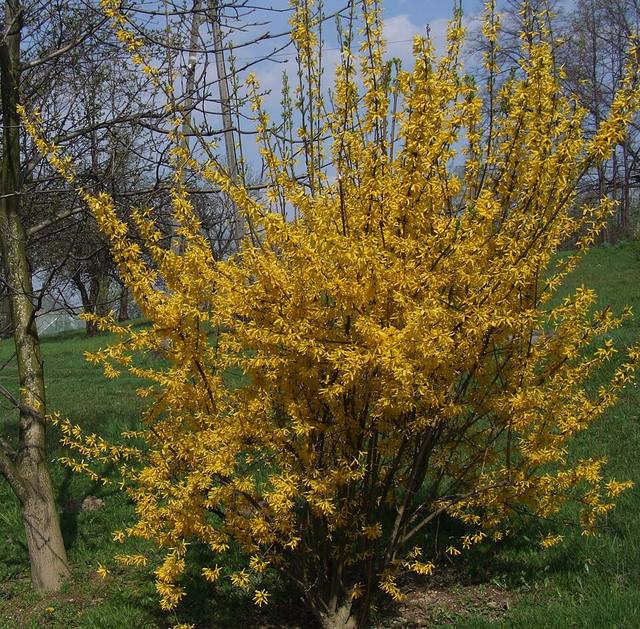
Photo: Jerzy Opioła · CC BY-SA 4.0 · Wikimedia Commons

Forsythia
Forsythia intermedia
Also called Golden bells, Border forsythia
Shrub · Family Oleaceae · Native to Garden hybrid (of Chinese origin)
A spreading deciduous shrub covered in bright yellow flowers in early spring, before the leaves. It is very hardy and easy, and good as a hedge or specimen.
The ASPCA lists this plant as non-toxic to cats and dogs
Care
Light
Full sun
Flowers best in full sun to part shade. Deep shade gives few flowers. Bare, thin, leggy stems that do not bloom mean too little light or no pruning.
Water
About every 10 days in the growing season, every 21 in the cool season
Water new plants weekly in dry spells in the first year. Established shrubs hardly need watering. Waterlogged soil is the problem, not drought.
Water when the top 5 cm (2 in) of soil is dry
Humidity
Medium humidity
Outdoor air is fine.
Temperature
5 to 28 °C (41 to 82 °F)
Hardy to about -28 °C (-18 °F) when dormant. Flower buds can be lost in hard late frost. Grows in a wide range, 5 to 28 °C (41 to 82 °F).
Soil
Any reasonably well-drained soil, pH 6 to 7.5. It copes with chalk and clay but not waterlogging.
Feeding
Do not feed in most soils. A little slow-release fertiliser in spring on poor soil is enough.
Repotting
Not repotted in the ground. Do not move it unless needed; a pot-grown plant needs a bigger pot every 3 years.
Pruning
Prune right after flowering in spring, because it flowers on last year's wood. Cut out a third of the oldest stems at the base each year. Hard pruning later removes next year's flowers.
Propagation
Take softwood cuttings in early summer or hardwood cuttings in autumn. Branches that touch the ground root where they land, so you can layer them.
Size
150 to 300 cm (59 to 118 in)
Fast growing
Outdoors
USDA zones 5 to 9
Hardy shrub for a sunny to part-shaded spot, 1.5 to 2 m (5 to 6 ft) apart. It makes a loose hedge or a screen. Needs room.
Common problems
Few or no flowers
Pruned at the wrong time or too much shade
Prune right after flowering, and give more sun.
Flowers browned by frost
Late frost on open buds
Plant on a slope away from frost pockets; cut stems for indoor use.
Dead twigs and brown leaves
Dieback or honey fungus
Cut out dead wood; check roots for white fungus and replace if honey fungus is present.
Leggy, bare base
Never pruned
Cut a third of old stems to the ground after flowering for a few years.
Leaves chewed by birds
Birds eat the buds
Cover with netting or fleece if buds disappear.
Did you know?
Forsythia is named after William Forsyth, a Scottish gardener, and almost all garden forsythias descend from a few Chinese plants crossed in Europe.
General care information for a typical plant. Conditions in your home or garden may need a different rhythm.
Not sure what your plant is?
Identify a plant from a photoSee this guide in the appKagn Plants also keeps your own plants with watering reminders, and its plant doctor reads what is wrong with one.
Updated 22 November 2026.