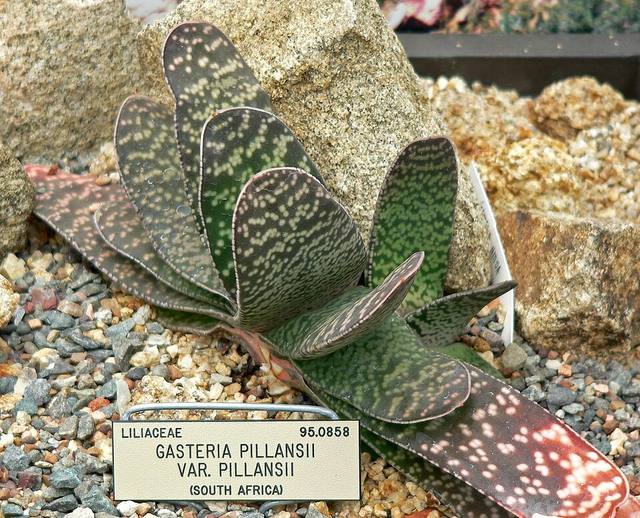
Photo: Stan Shebs · CC BY-SA 3.0 · Wikimedia Commons

Ox tongue
Gasteria
Also called Gasteria, Lawyer's tongue, Cow tongue
Succulent or cactus · Family Asphodelaceae · Native to South Africa
A South African succulent with thick, tongue-shaped leaves, often in two neat rows, speckled with white. It copes with shade and neglect better than most succulents.
Not on the ASPCA's list: keep it out of reach of pets.
Care
Light
Bright, indirect light
Bright light with some morning sun. It tolerates part shade better than most succulents. Leaves stretching or fading mean too little light, and red or brown patches mean too much sun.
Water
About every 12 days in the growing season, every 30 in the cool season
Water well, then let the mix dry out fully. It stores water in thick leaves. The commonest mistake is overwatering, which rots the base. Water far less in winter.
Water when the mix is completely dry, usually every 10 to 14 days
Humidity
Low humidity
Dry home air is fine.
Temperature
15 to 27 °C (59 to 81 °F)
Grows best at 15 to 27 °C (59 to 81 °F). Damage starts below 5 °C (41 °F). Keep it dry in cold weather.
Soil
A gritty cactus mix with extra perlite or grit. The pot must drain. A shallow terracotta pot suits it.
Feeding
Every 8 weeks in the growing season
Feed every 8 weeks in spring and summer at half strength, or only 2 or 3 times a year. Do not feed in winter.
Repotting
Every 2 years
Repot every 2 years in spring. It likes a snug pot.
Pruning
Cut off dead leaves at the base. Remove the flower stem when the flowers are spent.
Propagation
Remove offsets from the base with roots and pot them. Or pull a healthy leaf off cleanly, let it dry for 3 days and lay it on gritty mix; it roots in weeks.
Size
10 to 30 cm (4 to 12 in)
Slow growing
Outdoors
USDA zones 9 to 11
Grows outdoors in frost-free gardens in part shade and sharp drainage. Elsewhere keep it in a pot.
Common problems
Soft, black base
Root rot from overwatering
Remove it from the pot, cut away rot, dry it and repot in dry gritty mix.
Leaves stretch and pale
Too little light
Move it to a bright window.
Brown or reddish scorch
Strong direct sun
Move it to brighter shade, or acclimatise it slowly.
Wrinkled leaves
Underwatering
Water thoroughly, then let it dry out again.
White cottony patches
Mealybugs
Dab with alcohol on a cotton bud and repeat weekly.
Did you know?
The name comes from the Latin gaster, a belly, for the swollen base of the curved flowers. Its leaves arrange in two opposite rows when young.
General care information for a typical plant. Conditions in your home or garden may need a different rhythm.
Not sure what your plant is?
Identify a plant from a photoSee this guide in the appKagn Plants also keeps your own plants with watering reminders, and its plant doctor reads what is wrong with one.
Updated 22 November 2026.