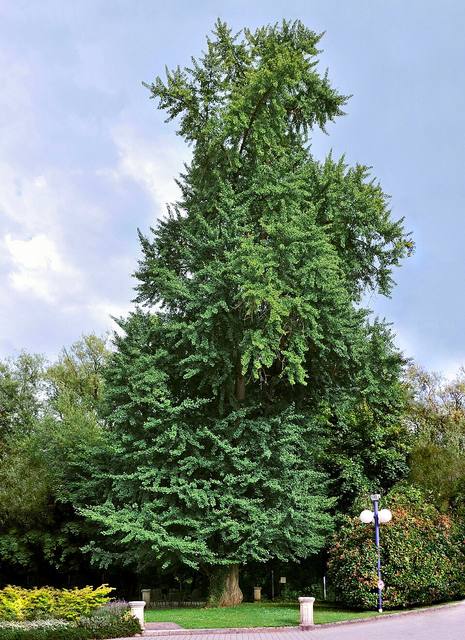
Photo: Cayambe; derivative work: Ginkgotree · CC BY-SA 3.0 · Wikimedia Commons

Ginkgo
Ginkgo biloba
Also called Maidenhair tree
Tree · Family Ginkgoaceae · Native to China
A tough, slow tree with fan-shaped leaves that turn clear gold in autumn. It survives pollution and city streets, and is the only living member of its family.
Not on the ASPCA's list: keep it out of reach of pets.
Care
Light
Full sun
Grows best in full sun but tolerates part shade. Good autumn colour needs sun.
Water
About every 14 days in the growing season, every 30 in the cool season
Water newly planted trees every 1 to 2 weeks in dry weather for 2 years. Established trees need none. It is dormant in winter.
Water young trees every 10 to 14 days in dry weather
Humidity
Medium humidity
Outdoor humidity is no concern.
Temperature
8 to 28 °C (46 to 82 °F)
Hardy to about -30 °C (-22 °F). Grows best at 8 to 28 °C (46 to 82 °F). Very few frost or heat problems.
Soil
Deep, well-drained, sandy loam. It tolerates poor soil, compaction, salt and wide pH, but not constant waterlogging.
Feeding
Do not feed. It grows well without it.
Repotting
Young trees can be grown in a large pot for some years. Plant out in the ground when it outgrows it.
Pruning
Needs little. Remove dead or crossing branches in late winter. Many cultivars have a naturally narrow shape.
Propagation
Seeds need stratifying and the soft fruit pulp removed with gloves. Most people buy a male grafted tree, because female trees drop smelly fruit.
Size
1000 to 2500 cm (394 to 984 in)
Slow growing
Outdoors
USDA zones 3 to 8
Plant a male tree in full sun with 8 m (26 ft) of space. Female trees drop foul-smelling fruit, so avoid them near paths.
Common problems
Leaves drop all at once in autumn
Normal behaviour
It is deciduous. The leaves often fall within a day or two after turning gold.
Fruit smells like rancid butter
A female tree
Plant a grafted male next time. Wear gloves, since the pulp irritates skin.
Slow growth for years
Normal for the species
Be patient. Water well while young and mulch.
Yellow leaves in summer
Waterlogged soil
Improve drainage or choose a drier spot.
Splits or scars on the trunk
Winter damage or mower injury
Keep mowers away and wrap young trunks in cold climates.
Did you know?
Ginkgo fossils almost identical to the living tree are about 200 million years old. Several trees within 2 km of the Hiroshima blast survived and re-sprouted.
General care information for a typical plant. Conditions in your home or garden may need a different rhythm.
Not sure what your plant is?
Identify a plant from a photoSee this guide in the appKagn Plants also keeps your own plants with watering reminders, and its plant doctor reads what is wrong with one.
Updated 22 November 2026.