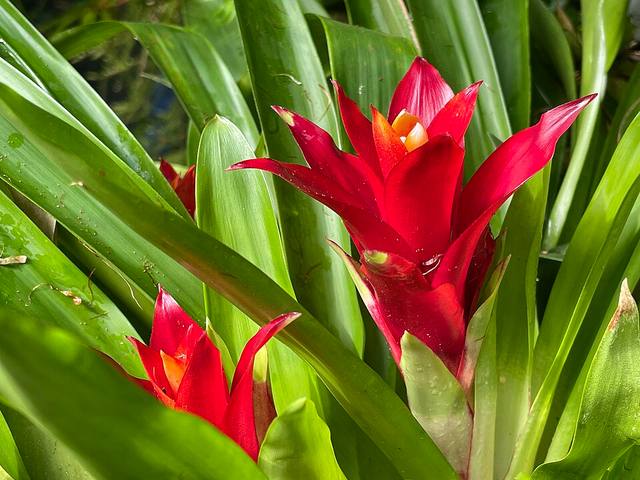
Photo: Amada44 · CC BY-SA 3.0 · Wikimedia Commons

Scarlet star
Guzmania lingulata
Also called Orange star, Tufted airplant, Guzmania
Houseplant · Family Bromeliaceae · Native to Central America, northern South America
A bromeliad with a rosette of glossy, strap-shaped leaves and a long-lasting, bright red or orange flower bract at its centre. It is bought for its colour and lasts months.
The ASPCA lists this plant as non-toxic to cats and dogs
Care
Light
Bright, indirect light
Bright, indirect light, with no hard midday sun. Too little light means the bract colour fades and no flower forms. Direct sun scorches the leaves.
Water
About every 7 days in the growing season, every 10 in the cool season
Fill the central cup, or 'vase', with fresh water and empty it every few weeks. Water the soil lightly so it never stays wet. Rainwater is best.
Keep the central cup one-quarter full and the soil barely damp
Humidity
High humidity
It likes 50 to 60 percent humidity or more. Brown leaf tips show dry air.
Temperature
16 to 28 °C (61 to 82 °F)
Keep it at 16 to 28 °C (61 to 82 °F). It is damaged below about 10 °C (50 °F).
Soil
A very light, airy mix of bark, perlite and peat. It has small roots and mainly grips, so use a small pot with good drainage.
Feeding
Every 8 weeks in the growing season
Feed every 8 weeks in the growing season at quarter strength, into the soil or lightly on the leaves. Do not put feed in the central cup.
Repotting
The mother plant flowers once and then slowly dies. Do not repot: grow the pups on in new pots instead.
Pruning
Cut off the old flower stalk once it browns. Remove brown, dead leaves at the base.
Propagation
After flowering, the plant makes pups at the base. When they are one-third the size of the parent, cut them off with roots and pot them separately.
Size
30 to 60 cm (12 to 24 in)
Slow growing
Outdoors
USDA zones 10 to 12
Grown outdoors in frost-free, humid, shady gardens on trees or in pots. Elsewhere it is a houseplant.
Common problems
Brown, rotting centre
Stagnant water in the cup
Flush and refill with fresh water, and empty the cup every 2 weeks.
Flower bract fades and leaves brown
Natural end of the mother plant
Keep it until it dies and grow the pups on.
Brown leaf tips
Dry air or hard tap water
Use rainwater and raise humidity.
No flower forms
Too little light or age
Provide brighter light. Mature plants may flower after a year or more.
Soft, brown base
Overwatering
Let the soil dry and keep water in the cup only.
Did you know?
Each rosette flowers only once. The mother plant slowly dies after flowering, but it leaves pups at the base that carry on.
General care information for a typical plant. Conditions in your home or garden may need a different rhythm.
Not sure what your plant is?
Identify a plant from a photoSee this guide in the appKagn Plants also keeps your own plants with watering reminders, and its plant doctor reads what is wrong with one.
Updated 22 November 2026.