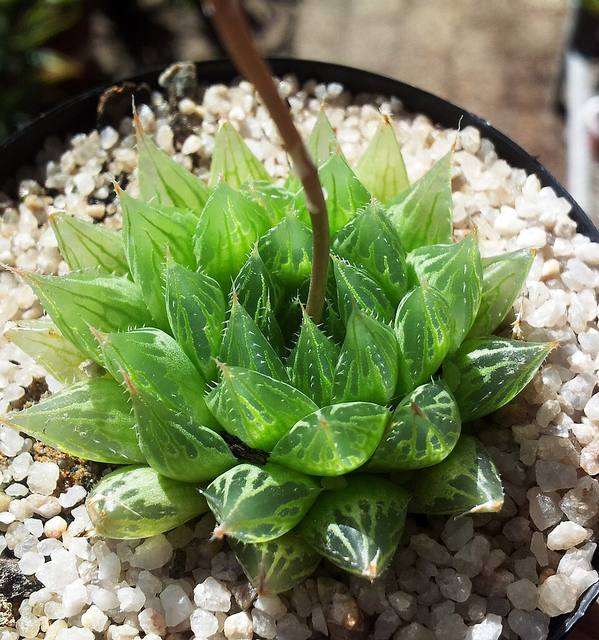
Photo: Abu Shawka · CC0 · Wikimedia Commons

Cooper's haworthia
Haworthia cooperi
Also called Cooper's haworthia, Window haworthia
Succulent or cactus · Family Asphodelaceae · Native to South Africa (Eastern Cape)
A small rosette succulent with plump, see-through, jelly-like leaves. It grows slowly in low light and is easy to keep on a desk or shelf.
The ASPCA lists this plant as non-toxic to cats and dogs
Care
Light
Bright, indirect light
Bright indirect light. Direct sun through glass can scorch or redden the leaves. Low light makes it stretch. Morning sun is fine.
Water
About every 14 days in the growing season, every 28 in the cool season
Water thoroughly, then let it dry out. The plump leaves store water, so it forgives a missed watering but not a wet pot. Soft, dark leaves mean too much water.
Water when the soil is dry right through
Humidity
Low humidity
Dry room air is fine.
Temperature
12 to 28 °C (54 to 82 °F)
Best at 12 to 28 °C (54 to 82 °F). Keep above about 3 °C (37 °F).
Soil
Gritty cactus mix with extra perlite or pumice. Use a shallow pot with drainage holes.
Feeding
Every 8 weeks in the growing season
Feed every 8 weeks in spring and summer with weak cactus fertiliser. Not needed in winter.
Repotting
Every 3 years
Repot every 3 years when offsets crowd the pot. Handle the clump gently.
Pruning
Cut away dead lower leaves and the dry flower stem.
Propagation
Separate offsets with a little root in spring and pot them in gritty mix. Leaf cuttings are slow and unreliable.
Size
5 to 10 cm (2 to 4 in)
Slow growing
Outdoors
USDA zones 9 to 11
Grows outdoors in frost-free gardens in light shade, among rocks. Elsewhere indoors.
Common problems
Shrivelled, wrinkled leaves
Thirst
Water thoroughly and the leaves plump up.
Soft, brown base
Overwatering
Cut away rot, let dry and repot in dry gritty mix.
Brown or red leaves
Too much direct sun
Move to bright shade.
Stretched, pale rosette
Low light
Move to a brighter spot.
Cottony white fluff
Mealybugs
Wipe with an alcohol cotton bud.
Did you know?
The clear 'window' tips of the leaves let light into the buried part of the leaf, so it can photosynthesise while its tips are sand-covered.
General care information for a typical plant. Conditions in your home or garden may need a different rhythm.
Not sure what your plant is?
Identify a plant from a photoSee this guide in the appKagn Plants also keeps your own plants with watering reminders, and its plant doctor reads what is wrong with one.
Updated 22 November 2026.