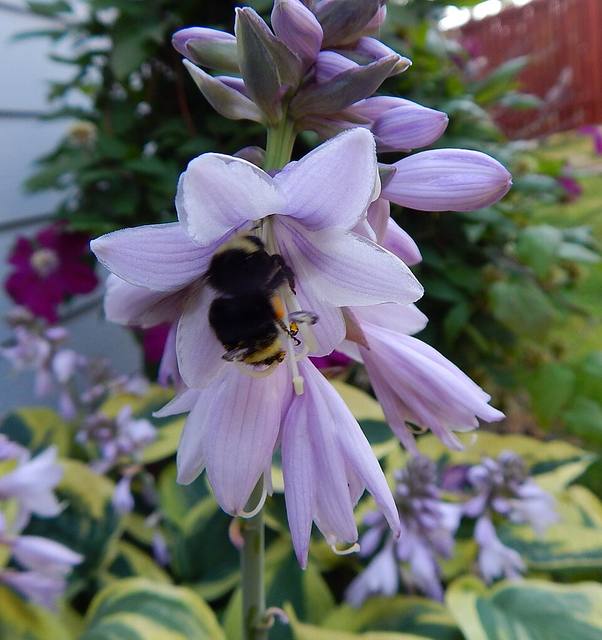
Photo: Ron Clausen · CC BY-SA 4.0 · Wikimedia Commons

Hosta
Hosta
Also called Plantain lily, Funkia
Garden flower · Family Asparagaceae · Native to Japan, Korea and China
A shade perennial grown for big, ribbed leaves in green, blue, gold or striped. It comes up each spring and slugs love it. Most garden hostas are hybrids.
Toxic to cats and dogs
Toxic principle: Saponins
Signs: Vomiting, diarrhea, depression.
Care
Light
Medium light
Part to full shade suits it. Blue-leaved types need shade, and gold types tolerate a few hours of morning sun. Brown, crisp leaf edges mean too much sun.
Water
About every 7 days in the growing season, every 30 in the cool season
Soak the soil weekly in dry weather, because the leaves lose a lot of water. It dies back in winter, so water only if it is dry. Potted plants dry out quickly.
Water when the top 3 to 5 cm (1 to 2 in) of soil is dry
Humidity
Medium humidity
Outdoor humidity is no concern. Brown edges on leaves usually mean dry soil or too much sun.
Temperature
10 to 25 °C (50 to 77 °F)
Hardy to about -34 °C (-29 °F). It needs a cold winter, and it dies back to the ground after frost.
Soil
Rich, moisture-holding but well-drained soil with plenty of compost, in shade. Slightly acid to neutral. Add mulch to keep the roots cool.
Feeding
Every 8 weeks in the growing season
Feed in spring as the shoots appear with a slow-release feed or compost, and again in early summer. About every 8 weeks.
Repotting
Every 4 years
Divide every 4 to 5 years in early spring or late summer when the clump gets large or the centre is bare.
Pruning
Cut off leaf stalks when they flop and the flower stalks once finished. Cut all leaves to the ground after they turn brown in autumn, and throw them away.
Propagation
Divide an established clump in spring as the shoots emerge. Cut it into pieces, each with 2 to 3 shoots and roots. Replant at the same depth.
Size
20 to 90 cm (8 to 35 in)
Medium growth
Outdoors
USDA zones 3 to 9
Plant in shade or dappled shade, 30 to 90 cm (1 to 3 ft) apart, depending on leaf size. Keep away from tree roots that dry the soil.
Common problems
Holes in leaves, slime trails
Slugs and snails
Pick them off at night, use beer traps or copper barriers. Blue-leaved types are less hit.
Brown, crisp leaf edges
Too much sun or dry soil
Move into more shade and water deeply.
Leaves turn yellow in midsummer
Drought or heat
Water deeply. Some yellowing is normal in late summer.
Leaves shredded on a plant
Deer
Use netting or fencing. They eat hostas readily.
Spread of mushy, collapsing stems
Crown rot in wet soil
Lift, cut off rotten bits and replant in better-drained ground.
Did you know?
The genus was named for Nicolaus Host, an Austrian botanist. Thousands of cultivars have been bred, mostly from Japanese species.
General care information for a typical plant. Conditions in your home or garden may need a different rhythm.
Not sure what your plant is?
Identify a plant from a photoSee this guide in the appKagn Plants also keeps your own plants with watering reminders, and its plant doctor reads what is wrong with one.
Updated 22 November 2026.