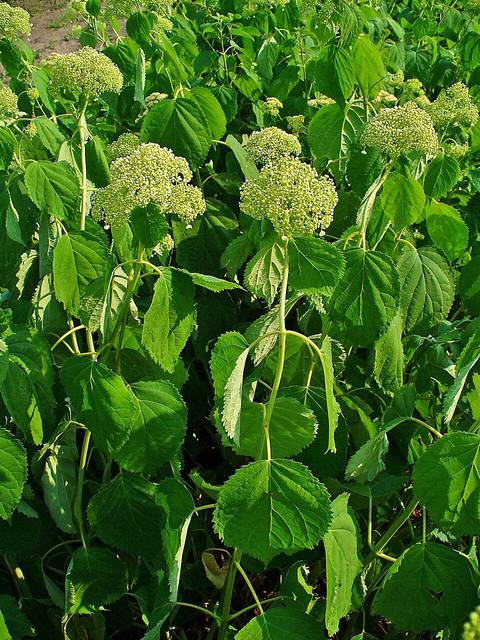
Photo: H. Zell · CC BY-SA 3.0 · Wikimedia Commons

Smooth hydrangea
Hydrangea arborescens
Also called Hills of snow, Sevenbark, Wild hydrangea, Annabelle
Shrub · Family Hydrangeaceae · Native to Eastern United States
A native North American shrub with big round white flower heads from early to late summer. It is hardy, easy, and flowers on new wood.
Toxic to cats and dogs
Toxic principle: Cyanogenic glycoside
Signs: Vomiting, depression, diarrhea. Cyanide intoxication is rare, usually produces more of a gastrointestinal disturbance
Care
Light
Part sun
Likes morning sun and afternoon shade. Full sun in hot areas scorches leaves. Dense shade gives weak stems and few flowers.
Water
About every 5 days in the growing season, every 14 in the cool season
Water deeply every week, and more in heat. It likes steady moisture and wilts fast in dry soil. It recovers after watering. Winter days apply to the dormant, leafless plant.
Water when the top 3 cm (1 in) of soil is dry
Humidity
Medium humidity
Outdoor air is fine.
Temperature
10 to 28 °C (50 to 82 °F)
Hardy to about -35 °C (-31 °F) when dormant. Grows best at 10 to 28 °C (50 to 82 °F). New stems flower even if cut by frost.
Soil
Moist, fertile, well-drained soil rich in humus, pH 5.5 to 7. Mulch to keep roots cool. Flower colour is not changed by pH.
Feeding
Every 8 weeks in the growing season
Feed in spring with a balanced slow-release fertiliser. Too much nitrogen gives weak, floppy stems.
Repotting
Not repotted in the ground. Divide a crowded clump in early spring every 5 to 6 years.
Pruning
Cut stems to 15 to 30 cm (6 to 12 in) in late winter. Hard pruning gives strong stems that carry the heavy flowers. Deadhead if you want.
Propagation
Divide the clump in early spring, or take softwood cuttings in early summer. Suckers can be dug up and replanted.
Size
90 to 150 cm (35 to 59 in)
Fast growing
Outdoors
USDA zones 3 to 9
Hardy shrub for a moist bed in part shade, 1.2 to 1.8 m (4 to 6 ft) apart. It suckers into a clump. Good for under trees.
Common problems
Floppy stems with heavy flowers
Weak stems after rain or too much feed
Prune hard each late winter and avoid high-nitrogen feeds.
Wilting in sun
Drought
Water deeply and mulch.
Brown leaf edges
Hot sun and dry roots
Move to part shade and water more.
White powder on leaves
Powdery mildew
Thin stems and water at the base.
Few flowers
Too much shade or pruned in summer
Give morning sun and prune only in late winter.
Did you know?
'Annabelle' is the best-known smooth hydrangea; it was found growing wild in Anna, Illinois, around 1910.
General care information for a typical plant. Conditions in your home or garden may need a different rhythm.
Not sure what your plant is?
Identify a plant from a photoSee this guide in the appKagn Plants also keeps your own plants with watering reminders, and its plant doctor reads what is wrong with one.
Updated 22 November 2026.