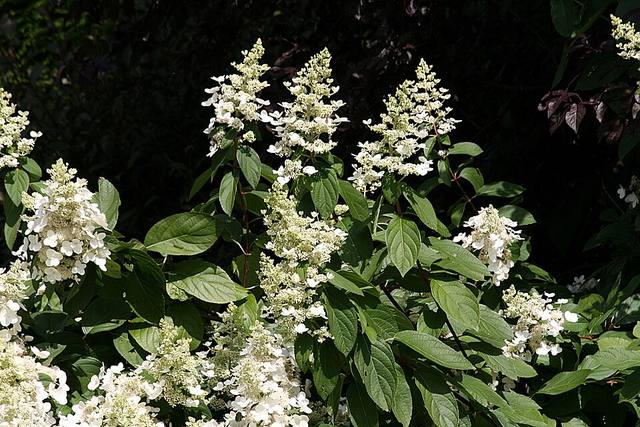
Photo: Hedwig Storch · CC BY-SA 3.0 · Wikimedia Commons

Panicle hydrangea
Hydrangea paniculata
Also called Paniculata hydrangea, Limelight hydrangea
Shrub · Family Hydrangeaceae · Native to China, Japan and Sakhalin
A tough, hardy shrub with cone-shaped flower heads that open white or cream and turn pink in autumn. It is easier and hardier than the mophead hydrangea.
The ASPCA lists a close relative, hills of Snow (Hydrangea arborescens), as toxic to cats and dogs: treat this plant the same.
Care
Light
Full sun
Best in full sun to light shade; flowers well in sun if the soil stays moist. Deep shade gives few flowers and floppy stems. Brown, crisp leaf edges mean heat and drought.
Water
About every 7 days in the growing season, every 14 in the cool season
Water deeply every week in dry spells; potted shrubs need water more often. It tolerates short dry spells better than mophead types. Wilting leaves in the afternoon mean it wants a drink.
Water when the top 3 cm (1 in) of soil is dry
Humidity
Medium humidity
Outdoor air is fine. It is not fussy about humidity.
Temperature
10 to 28 °C (50 to 82 °F)
Hardy to about -35 °C (-31 °F) when dormant; it flowers on new wood, so frost seldom costs flowers. Grows best at 10 to 28 °C (50 to 82 °F).
Soil
Moist, fertile, well-drained soil, pH 5.5 to 7. It copes with chalk better than mophead types. Mulch to keep roots cool.
Feeding
Every 8 weeks in the growing season
Feed in spring with a balanced slow-release fertiliser, and again in early summer. Avoid late summer feeding.
Repotting
Not repotted in the ground. In a pot, move to a bigger one every 3 years in early spring.
Pruning
Prune in late winter or early spring: cut stems back by one third to a half to a pair of strong buds. Flowers form on new growth, so hard pruning is safe.
Propagation
Take softwood cuttings in early summer and root in a gritty mix. Division of suckers also works in autumn or spring.
Size
150 to 300 cm (59 to 118 in)
Medium growth
Outdoors
USDA zones 3 to 8
Hardy shrub for a sunny to part-shaded bed, 1.5 to 2.5 m (5 to 8 ft) apart. It is a good hedge or specimen shrub, with a long season of flowers.
Common problems
Few flowers
Too much shade or pruned wrongly
Give it sun and prune in late winter, leaving some strong stems.
Wilting leaves in hot afternoon
Drought
Water deeply and mulch; it recovers once watered.
Floppy flower heads
Heavy heads after rain or too much feed
Prune harder in spring and avoid high-nitrogen feeds.
Brown leaf edges
Hot sun and dry soil
Water more and mulch.
Brown flower heads that stay
Natural drying
Leave for autumn colour or cut in late winter.
Did you know?
Paniculata flower heads change colour as they age: white in summer to pink then burgundy in autumn, regardless of the soil pH.
General care information for a typical plant. Conditions in your home or garden may need a different rhythm.
Not sure what your plant is?
Identify a plant from a photoSee this guide in the appKagn Plants also keeps your own plants with watering reminders, and its plant doctor reads what is wrong with one.
Updated 22 November 2026.