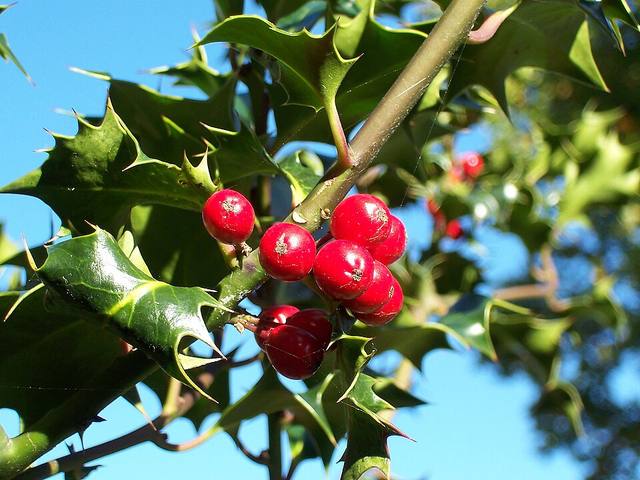
Photo: Jürgen Howaldt · CC BY-SA 2.0 de · Wikimedia Commons

English holly
Ilex aquifolium
Also called Common holly, European holly, Christmas holly
Shrub · Family Aquifoliaceae · Native to Europe, northwest Africa and southwest Asia
A slow, evergreen shrub or tree with glossy spiny leaves and red berries on female plants. Grown for winter colour, Christmas cuttings and a dense, stock-proof hedge.
Toxic to cats and dogs
Toxic principle: Saponins
Signs: Vomiting, diarrhea and depression. Leaves and berries are low toxicity.
Care
Light
Part sun
Grows in sun or part shade. Variegated types colour best in sun. Deep shade gives thin, open growth and fewer berries.
Water
About every 14 days
Water a new plant deeply once a week in dry weather for the first two summers. Established holly rarely needs water. Do not water in winter unless the soil is dry, because holly dislikes sitting in wet soil.
Water new plants when the top 5 cm (2 in) of soil is dry
Humidity
Medium humidity
Outdoor humidity is no concern. It handles wind, cold and city air well.
Temperature
-5 to 27 °C (23 to 81 °F)
Hardy to about -23 °C (-10 °F). Grows best in a cool temperate climate. Hot, dry summers stress it.
Soil
Any reasonably drained soil, rich in organic matter. It tolerates clay, chalk and acid soil. Avoid soil that floods in winter.
Feeding
Established plants need no regular feeding. Spread a layer of compost or leaf mould in spring to feed it.
Repotting
Nothing to repot. Plant in autumn or spring and move small plants only. Large holly resents being moved.
Pruning
Trim hedges in late summer or in spring. Cut stems with secateurs, not shears, to avoid ragged leaves. Cut out dead wood and reduce height in spring. Wear thick gloves.
Propagation
Take semi-ripe cuttings in late summer, or buy named female plants. Seed takes up to 2 years to germinate and gives a mix of male and female plants.
Size
300 to 1500 cm (118 to 591 in)
Slow growing
Outdoors
USDA zones 6 to 9
Plant in sun or part shade, 60 to 90 cm (2 to 3 ft) apart for a hedge. For berries you need a male plant within reach of the female.
Common problems
Plant has leaves but never gives berries
Only a male plant, or no male nearby
Berries only form on female plants. Add a male holly or a self-fertile type such as 'J.C. van Tol'.
Leaves turn yellow and drop in spring
Old leaves fall naturally, or wet soil
Some leaf fall in late spring is normal. If many leaves drop, check drainage and water.
Yellow or brown blotches and tunnels in leaves
Holly leaf miner
Pick off and bin affected leaves in early summer. Keep the plant healthy so new growth hides the damage.
Dark spots and early leaf drop
Leaf spot fungus in a wet or crowded spot
Clear fallen leaves and open up the plant to let air in. Water at the base.
Brown scorched leaves after a cold wind
Winter wind burn
Plant in shelter. Most plants recover and grow new leaves in spring.
Did you know?
Only female hollies carry the red berries, and a berried branch needs a male plant growing nearby to pollinate the flowers.
General care information for a typical plant. Conditions in your home or garden may need a different rhythm.
Not sure what your plant is?
Identify a plant from a photoSee this guide in the appKagn Plants also keeps your own plants with watering reminders, and its plant doctor reads what is wrong with one.
Updated 22 November 2026.