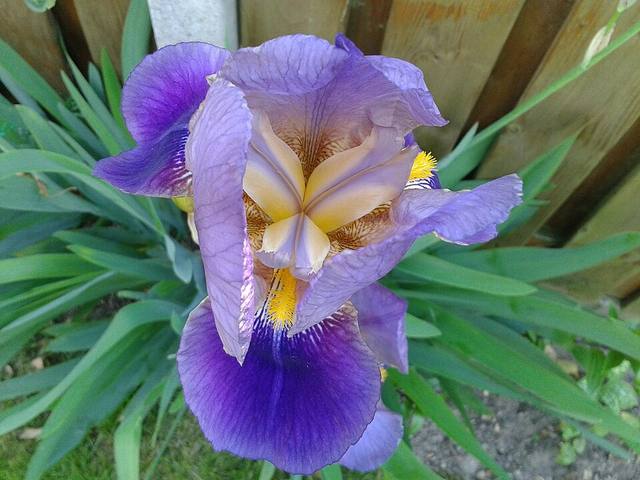
Photo: User:GinoMM · CC BY-SA 3.0 · Wikimedia Commons

Bearded iris
Iris germanica
Also called German iris, Flag iris
Garden flower · Family Iridaceae · Native to Mediterranean and Europe (garden hybrid origin)
A tough perennial with sword-shaped leaves and frilly, bearded flowers in late spring. It comes in almost every colour, grows from a rhizome and does best in dry, sunny beds.
Toxic to cats and dogs
Toxic principle: Pentacylic terpenoids (zeorin, missourin and missouriensin)
Signs: Salivation, vomiting, drooling, lethargy, diarrhea. Highest concentration in rhizomes.
Care
Light
Full sun
Needs full sun, at least 6 hours. In shade it flowers poorly and rots more easily.
Water
About every 10 days in the growing season, every 30 in the cool season
Established clumps rarely need water. Water new plants weekly for a month, and in long dry spells. Wet soil rots the rhizome, which is the commonest cause of loss.
Water when the top 5 cm (2 in) of soil is dry
Humidity
Low humidity
Dry air is fine. Good air flow keeps leaf spot and rot away.
Temperature
10 to 27 °C (50 to 81 °F)
Hardy to about -34 °C (-29 °F). It copes with heat and drought.
Soil
Well-drained, neutral to slightly alkaline soil, in raised ground if heavy. Plant the rhizome shallow, with its top showing above the soil surface.
Feeding
Every 8 weeks in the growing season
Give a light feed of low-nitrogen feed or bone meal in early spring and after flowering. Too much nitrogen means soft growth and rot.
Repotting
Every 3 years
Lift and divide every 3 to 4 years, in late summer after flowering, when the clump is crowded and flowers fade.
Pruning
Cut off faded stems at the base. Trim dead leaf tips in a fan shape, and remove old leaves in autumn to reduce disease.
Propagation
Divide rhizomes in July to September. Cut healthy pieces with a fan of leaves and roots, throw out the old centre. Trim leaves to 15 cm (6 in) and replant shallow.
Size
50 to 120 cm (20 to 47 in)
Medium growth
Outdoors
USDA zones 3 to 9
Plant rhizomes in sun in summer, 30 to 45 cm (12 to 18 in) apart, with the tops showing. Give space and air.
Common problems
Rhizome soft and smelly
Bacterial soft rot from wet soil or deep planting
Dig up and cut away all soft tissue. Let it dry in the sun, and replant shallow in dry soil.
No flowers
Too much shade, too deep or crowded
Move to full sun, replant shallow and divide old clumps.
Brown spots on leaves
Leaf spot fungus
Cut off affected leaves and clean up fallen ones.
Holes bored into leaves and rhizome
Iris borer
Squash caterpillars in spring. Remove and bin infested rhizomes.
Leaves and flowers eaten
Slugs
Pick off at night.
Did you know?
Orris root, a perfume ingredient, comes from the dried rhizomes of Iris germanica and related irises, and was used for scent for hundreds of years.
General care information for a typical plant. Conditions in your home or garden may need a different rhythm.
Not sure what your plant is?
Identify a plant from a photoSee this guide in the appKagn Plants also keeps your own plants with watering reminders, and its plant doctor reads what is wrong with one.
Updated 22 November 2026.