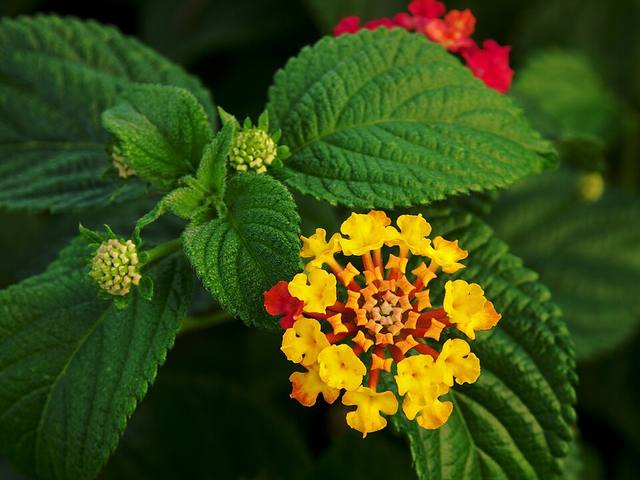
Photo: Alvesgaspar · CC BY-SA 3.0 · Wikimedia Commons

Lantana
Lantana camara
Also called Common lantana, Shrub verbena, Wild sage
Shrub · Family Verbenaceae · Native to Tropical Americas
A tough, sun-loving shrub with clusters of small flowers that change colour as they age. Butterflies love it, but it spreads and is a noxious weed in many warm regions.
Toxic to cats and dogs
Toxic principle: Pentacyclic triterpenoids
Signs: Vomiting, diarrhea, labored breathing, weakness. Liver failure, more common in livestock.
Care
Light
Full sun
Needs full sun, 6 or more hours. In shade it grows leggy with few flowers.
Water
About every 7 days in the growing season, every 14 in the cool season
Water deeply once a week in hot weather while it settles in. Established plants handle drought well. Wet soil in cool weather rots the roots, so water less in winter.
Water when the top 5 cm (2 in) of soil is dry
Humidity
Low humidity
Copes with dry air. Humid, still air can bring mildew on leaves.
Temperature
15 to 32 °C (59 to 90 °F)
Best at 15 to 32 °C (59 to 90 °F). Frost cuts it to the ground, about -1 °C (30 °F). It regrows in zones 8 to 9 if roots survive.
Soil
Well-drained soil of average fertility. Poor, sandy soil is fine. Rich soil gives leaves instead of flowers.
Feeding
Every 6 weeks in the growing season
Feed lightly every 6 weeks in spring and summer, or not at all in the ground. Too much feed gives leaves, not flowers.
Repotting
In a pot, move up a size in spring when roots circle the pot. In the ground it needs no moving.
Pruning
Cut back by a third to a half in spring once frost is over. Trim after each flush of flowers. Wear gloves, because leaves can irritate skin.
Propagation
Take 10 cm (4 in) softwood cuttings in spring or summer and root them in moist potting mix. They root in 2 to 3 weeks.
Size
60 to 200 cm (24 to 79 in)
Fast growing
Outdoors
USDA zones 9 to 11
Grows as a shrub in zones 9 to 11 and as a summer annual elsewhere. Plant in full sun. Check local rules: it is an invasive weed in many places.
Common problems
Few flowers, lots of leaves
Too much feed or too little sun
Move to full sun and stop feeding. Flowers form on new growth, so prune lightly.
White powder on leaves
Powdery mildew
Give more air and sun. Remove badly marked leaves.
White fluffy specks, sticky leaves
Whitefly
Rinse leaves with water and wipe with soapy water, repeating weekly.
Plant sprawls and self-seeds into the garden
Berries spread by birds
Cut off flower heads before they turn into berries. Choose sterile cultivars if you can.
Yellow leaves, soft stems in winter
Wet cold soil
Plant in raised or gritty soil and water sparingly in cool months.
Did you know?
Lantana flowers are yellow on the first day, then orange and red as they age, so one flower head shows several colours at once.
General care information for a typical plant. Conditions in your home or garden may need a different rhythm.
Not sure what your plant is?
Identify a plant from a photoSee this guide in the appKagn Plants also keeps your own plants with watering reminders, and its plant doctor reads what is wrong with one.
Updated 22 November 2026.