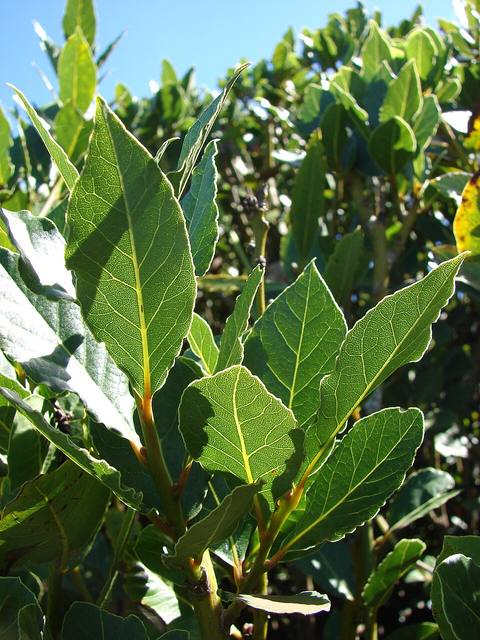
Photo: Forest and Kim Starr · CC BY 3.0 us · Wikimedia Commons

Bay laurel
Laurus nobilis
Also called Bay, Sweet bay, Bay tree, Grecian laurel
Herb · Family Lauraceae · Native to Mediterranean region
An evergreen shrub or small tree with glossy, aromatic leaves used to flavour cooking. It is grown in a pot or hedge, and can also be clipped into balls or standards.
Toxic to cats and dogs
Toxic principle: Eugenol, and other essential oils
Signs: Vomiting and diarrhea, Large ingestion of whole leaves can cause obstruction
Care
Light
Part sun
Full sun to part shade. It tolerates shade but grows densest in sun. Indoors a bright window is fine; outdoors shelter from cold winds scorches its leaves.
Water
About every 7 days in the growing season, every 14 in the cool season
Water deeply, then let the top dry. It dislikes waterlogged soil, and a potted tree needs regular water in summer. Brown leaf edges mean drought or cold wind.
Water when the top 3 cm (1 in) of soil is dry
Humidity
Low humidity
Normal room humidity is fine.
Temperature
10 to 30 °C (50 to 86 °F)
Best at 10 to 30 °C (50 to 86 °F). Hardy to about -8 °C (18 °F) in a sheltered spot. Young plants are tender, so protect them from frost.
Soil
Free-draining, fertile soil or a loam-based compost with grit. Neutral to slightly acidic. Use a pot with drainage holes.
Feeding
Every 6 weeks in the growing season
Feed every 6 weeks in spring and summer with a balanced fertiliser. Not in winter.
Repotting
Every 3 years
Repot a potted tree every 3 years in spring into a slightly bigger pot, or refresh the top soil. It is slow growing.
Pruning
Clip in summer to shape with secateurs, cutting stems rather than leaves, as cut leaves brown at the edge. Remove dead wood in spring.
Propagation
Take semi-ripe cuttings in late summer. They root slowly with warmth and humidity, over 2 to 3 months. Or detach rooted suckers.
Size
150 to 600 cm (59 to 236 in)
Slow growing
Outdoors
USDA zones 8 to 11
Grows outdoors in sun or part shade, sheltered from cold winds. Space 2 to 3 m (6 to 10 ft) apart. In colder areas grow in a pot and move it indoors.
Eating
Leaves, used whole in cooking and removed before serving
The whole leaves are tough and sharp-edged: remove them before eating. Not to be confused with cherry laurel or mountain laurel, which are poisonous.
Common problems
Brown leaf edges or tips
Cold wind, frost or drought
Shelter and water regularly in summer.
Sticky leaves with black sooty film
Scale insects
Wipe off scale and treat; clean the leaves.
Leaves yellow and drop
Overwatering or poor drainage
Let the top dry and check drainage.
Tips die back after a hard winter
Frost damage
Cut back to green wood in spring.
White, fluffy patches
Mealybugs or scale
Wipe off and keep the plant airy.
Did you know?
The Greek and Roman 'laurel wreath' for victors was made from its branches. The word 'baccalaureate' comes from the laurel berry.
General care information for a typical plant. Conditions in your home or garden may need a different rhythm.
Not sure what your plant is?
Identify a plant from a photoSee this guide in the appKagn Plants also keeps your own plants with watering reminders, and its plant doctor reads what is wrong with one.
Updated 22 November 2026.