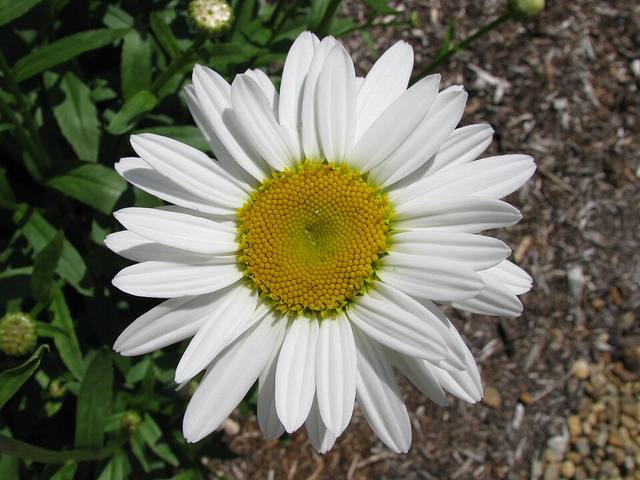
Photo: Captain-tucker · CC BY-SA 3.0 · Wikimedia Commons

Shasta daisy
Leucanthemum superbum
Also called Shasta, Garden daisy
Garden flower · Family Asteraceae · Native to Garden hybrid (European parents)
A clump-forming perennial with large white daisies with yellow centres from early to late summer. It is easy, long-lived and a good cut flower.
The ASPCA lists a close relative, chrysanthemum (Chrysanthemum spp.), as toxic to cats and dogs: treat this plant the same.
Care
Light
Full sun
Needs full sun, at least 6 hours. In shade it flowers little and the stems lean.
Water
About every 5 days in the growing season, every 21 in the cool season
Soak it once a week in dry weather in the first year, then every 7 to 10 days in a dry spell. It dislikes constant wet soil, which rots the crown, especially in winter.
Water when the top 3 cm (1 in) of soil is dry
Humidity
Medium humidity
Outdoor humidity is no problem. Close planting in damp air invites mildew.
Temperature
12 to 27 °C (54 to 81 °F)
Hardy to about -30 °C (-22 °F). Grows best at 12 to 27 °C (54 to 81 °F). The leaves shrink to a rosette in winter.
Soil
Fertile, well-drained soil with some compost. Winter wet is the killer, so add grit to heavy clay. Slightly acid to neutral.
Feeding
Every 6 weeks in the growing season
Add compost in spring and feed every 6 weeks with a balanced feed. Too much nitrogen gives leaves, not flowers.
Repotting
Every 3 years
Dig up and divide every 2 to 3 years in spring or autumn. Old clumps die out in the middle and flower less.
Pruning
Deadhead to prolong flowering. Cut stems to the base after flowering ends, and tall types may need staking or a cut back in early summer.
Propagation
Divide clumps in spring or autumn: each piece with roots and shoots will grow. Cuttings from basal shoots in spring also work.
Size
40 to 100 cm (16 to 39 in)
Medium growth
Outdoors
USDA zones 4 to 9
Grows in full sun in borders and cut-flower beds. Space plants 40 to 50 cm (16 to 20 in) apart. Needs good drainage in winter.
Common problems
Plant lies flat after rain
Tall stems with no support
Stake early, or cut the plant back by a third in early summer.
Crown rots in winter
Wet, heavy soil
Lift and replant with grit, or plant on a slight mound.
White powder on leaves
Powdery mildew
Give more space, water at the base and cut off affected leaves.
Centre of clump dies
Clump is old and crowded
Dig up, divide and replant the young outer pieces.
Chewed leaves and buds
Slugs, snails or earwigs
Check at night, pick them off and clear debris from around the base.
Did you know?
It was bred by Luther Burbank in California in the 1890s from several daisies, and named after Mount Shasta for its snow-white flowers.
General care information for a typical plant. Conditions in your home or garden may need a different rhythm.
Not sure what your plant is?
Identify a plant from a photoSee this guide in the appKagn Plants also keeps your own plants with watering reminders, and its plant doctor reads what is wrong with one.
Updated 22 November 2026.