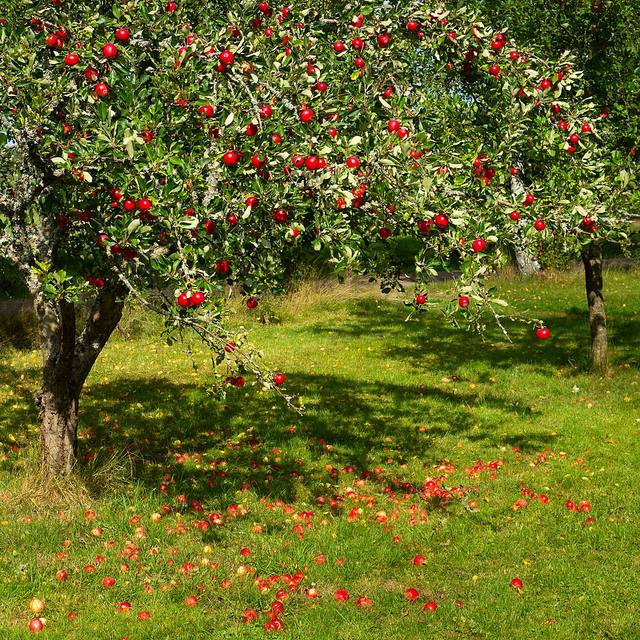
Photo: W.carter · CC0 · Wikimedia Commons

Apple
Malus domestica
Also called Apple tree, Orchard apple
Tree · Family Rosaceae · Native to Central Asia (garden origin)
The common orchard apple tree, with spring blossom and fruit in late summer or autumn. Thousands of cultivars exist, and most need a second type nearby to set fruit.
Toxic to cats and dogs
Toxic principle: Cyanogenic glycosides
Signs: Stems, leaves, seeds contain cyanide, particularly toxic in the process of wilting: brick red mucous membranes, dilated pupils, difficulty breathing, panting, shock.
Care
Light
Full sun
Needs full sun, at least 6 hours. In shade it flowers less and gets more disease.
Water
About every 10 days in the growing season, every 30 in the cool season
Water young trees weekly in dry weather for 2 years. Established trees need water only in long dry spells, especially while the fruit swells. Water the whole root zone, not just the trunk.
Water when the top 5 cm (2 in) of soil is dry
Humidity
Medium humidity
Outdoor humidity is no concern. Moist, still air favours scab and mildew.
Temperature
10 to 25 °C (50 to 77 °F)
Hardy to about -25 °C (-13 °F), depending on cultivar. It needs winter cold, so it does poorly in warm winters. Late spring frost can kill blossom.
Soil
Deep, fertile, well-drained loam, slightly acid to neutral. It dislikes waterlogged or very light soil. Mulch young trees.
Feeding
Every 52 weeks in the growing season
Feed once a year in early spring with a balanced feed or compost. Avoid heavy nitrogen, which gives leaves and less fruit.
Repotting
Not repotted when in the ground. A dwarf tree in a pot needs fresh compost and a larger pot every 3 to 4 years.
Pruning
Prune in winter while it is dormant to keep an open centre and remove crossing, dead and diseased branches. Thin fruit in early summer to get bigger apples and avoid every-other-year crops.
Propagation
Buy a grafted tree. Pips do not give true copies of the parent, and grafting onto a rootstock is how trees are made and controlled in size.
Size
200 to 800 cm (79 to 315 in)
Medium growth
Outdoors
USDA zones 4 to 8
Plant bare-root in winter or potted in spring, in full sun. Space trees 2 to 6 m (6 to 20 ft) apart, depending on rootstock. Plant a pollination partner nearby.
Eating
Flesh of the fruit
Seeds, stems and leaves contain cyanogenic compounds. Do not eat the pips in quantity, and keep cores and fallen branches from pets.
Common problems
Olive-brown scab on leaves and fruit
Apple scab
Rake up and bin fallen leaves. Prune for air flow. Choose resistant cultivars.
Blossom but no fruit
No pollination partner or frost
Plant a second compatible cultivar nearby and protect blossom in frost.
Fruit has a worm hole and brown tunnel
Codling moth
Hang pheromone traps in early summer and pick up fallen fruit.
Fruit one year, none the next
Biennial bearing
Thin fruitlets in early summer and prune to balance growth.
Brown, shrivelled branch tips that look scorched
Fire blight
Cut out affected branches well below the damage and burn them.
Did you know?
About a quarter of an apple's volume is air, which is why it floats in water.
General care information for a typical plant. Conditions in your home or garden may need a different rhythm.
Not sure what your plant is?
Identify a plant from a photoSee this guide in the appKagn Plants also keeps your own plants with watering reminders, and its plant doctor reads what is wrong with one.
Updated 22 November 2026.