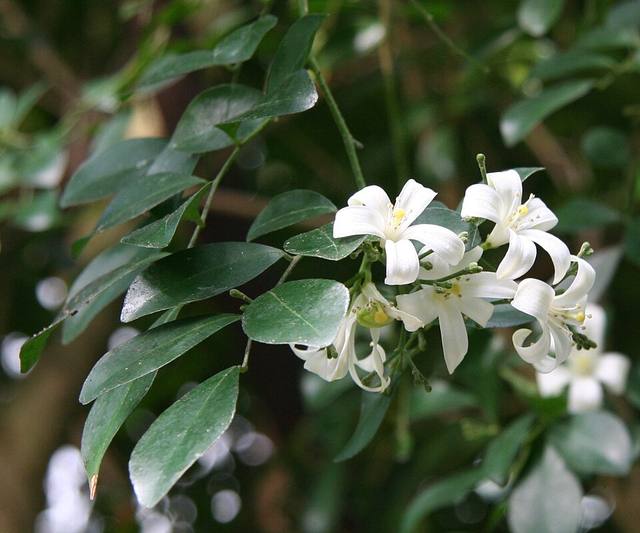
Photo: Michael Wolf · CC BY-SA 3.0 · Wikimedia Commons

Orange jasmine
Murraya paniculata
Also called Mock orange, Orange jessamine, Chinese box
Shrub · Family Rutaceae · Native to South and Southeast Asia to Australia
A dense, glossy evergreen shrub with clusters of very fragrant white flowers, followed by small red berries. It is used as a hedge or a pot plant in warm climates.
Not on the ASPCA's list: keep it out of reach of pets.
Care
Light
Part sun
Full sun to light shade. It flowers best with 4 to 6 hours of sun. In deep shade it grows leggy with few flowers.
Water
About every 5 days in the growing season, every 10 in the cool season
Water deeply, then let the top dry. Established plants cope with short dry spells. Water less in winter. Yellow leaves usually mean soggy roots.
Water when the top 3 cm (1 in) of soil is dry
Humidity
Medium humidity
Normal humidity is fine. Dry, heated rooms bring leaf drop and spider mites.
Temperature
15 to 32 °C (59 to 90 °F)
Grows best at 15 to 32 °C (59 to 90 °F). It is frost tender: leaves are damaged near 2 °C (36 °F).
Soil
A rich, well-drained soil with plenty of compost. Slightly acid to neutral. In pots use a free-draining potting mix.
Feeding
Every 4 weeks in the growing season
Feed every 4 weeks in spring and summer with a balanced feed. Do not feed in winter.
Repotting
Every 3 years
Repot a potted plant every 2 to 3 years in spring, one size up.
Pruning
Trim after a flush of flowers to keep it neat. It can be cut hard into a hedge in spring and takes shaping well.
Propagation
Take semi-ripe cuttings 10 cm (4 in) long in summer and root them in damp sandy mix. Seed from ripe red berries also grows readily.
Size
100 to 300 cm (39 to 118 in)
Medium growth
Outdoors
USDA zones 9 to 11
Grows outdoors as a hedge or specimen in frost-free gardens, in sun to part shade. Space hedge plants 60 to 90 cm (2 to 3 ft) apart.
Common problems
Yellow leaves
Wet roots or hunger
Check the drainage, water less and feed in the growing season.
Leaves drop
Cold, draught or dry air
Keep it warm and steady and away from heaters.
Few flowers
Too little sun or too much feed
Give more sun and use a feed lower in nitrogen.
Sticky leaves, white or brown bumps
Scale or aphids
Wipe off with soapy water and repeat weekly.
Webs and speckled leaves
Spider mites
Rinse the leaves and raise humidity.
Did you know?
The flowers smell strongest at night and in warm weather, and bloom several times a year. In some regions it is a host for a citrus pest, so local rules on planting it may apply.
General care information for a typical plant. Conditions in your home or garden may need a different rhythm.
Not sure what your plant is?
Identify a plant from a photoSee this guide in the appKagn Plants also keeps your own plants with watering reminders, and its plant doctor reads what is wrong with one.
Updated 22 November 2026.