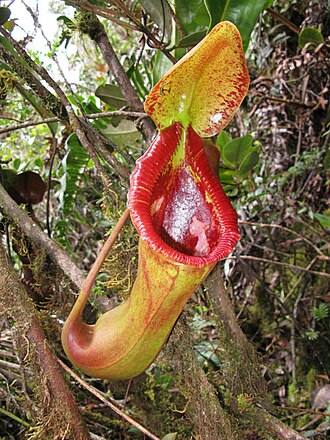
Photo: hirosi SBM · Public domain · Wikimedia Commons

Tropical pitcher plant
Nepenthes
Also called Monkey cup, Pitcher plant
Houseplant · Family Nepenthaceae · Native to Southeast Asia, Madagascar, northern Australia
A climbing carnivorous plant that hangs jug-shaped traps from the tips of its leaves. The traps catch small insects, and most plants sold are hybrids.
Not on the ASPCA's list: keep it out of reach of pets.
Care
Light
Bright, indirect light
Bright light with some direct sun. Too little light means no pitchers form. Lowland hybrids like more sun than highland ones.
Water
About every 3 days in the growing season, every 5 in the cool season
Use rainwater, distilled or reverse-osmosis water only: tap water minerals kill the roots. Keep the pot in a saucer of water in summer. Never let it dry out.
Keep the soil constantly moist: water when the top 1 cm (0.5 in) feels damp-dry
Humidity
High humidity
Most need 50 to 70 percent humidity. Pitchers dry and brown when the air is dry. A terrarium or humid shelf helps.
Temperature
18 to 30 °C (64 to 86 °F)
Most hybrids like 18 to 30 °C (64 to 86 °F) by day. Highland species want cool nights at 10 to 15 °C (50 to 59 °F). Damage begins below about 10 °C (50 °F).
Soil
A low-nutrient, airy mix of long-fibre sphagnum moss, perlite or bark. Never use ordinary potting soil or fertiliser in the soil. Use a hanging basket or a pot with drainage.
Feeding
Do not feed the roots. If you want, spray a very dilute feed on the leaves once a month, or let it catch insects on its own.
Repotting
Every 2 years
Repot every 2 years in spring into fresh sphagnum mix, in a pot only one size up. Do not disturb the roots much.
Pruning
Cut the vine back by half in spring if it gets long. New shoots form below the cut, and the cut piece can be rooted.
Propagation
Take a stem cutting with 2 to 3 leaves and a node, and root it in damp sphagnum moss in a humid, bright place. This takes several weeks.
Size
50 to 200 cm (20 to 79 in)
Medium growth
Outdoors
USDA zones 10 to 12
Highland species grow outdoors in cool tropical places, and lowland ones in warm humid gardens. Elsewhere, keep it as a houseplant or in a terrarium.
Common problems
Pitchers do not form
Too little light or dry air
Give brighter light and raise humidity to 60 percent or more.
Brown, shrivelled pitchers
Dry air or a natural old pitcher
Raise humidity. Cut off each pitcher once it is dead.
Leaves turn black
Tap-water minerals or fertiliser on roots
Switch to rainwater or distilled water and flush the pot well.
Plant stops growing
Cold nights for lowland plants or dry roots
Keep it warm and keep the moss constantly moist.
Pests on the new growth
Aphids, thrips or scale
Rinse with water or wipe with a damp cloth. Check weekly.
Did you know?
Nepenthes pitchers hold a digestive fluid that breaks down insects. The largest species can catch small frogs and rats. Some shrews visit to eat nectar and leave droppings in the trap.
General care information for a typical plant. Conditions in your home or garden may need a different rhythm.
Not sure what your plant is?
Identify a plant from a photoSee this guide in the appKagn Plants also keeps your own plants with watering reminders, and its plant doctor reads what is wrong with one.
Updated 22 November 2026.