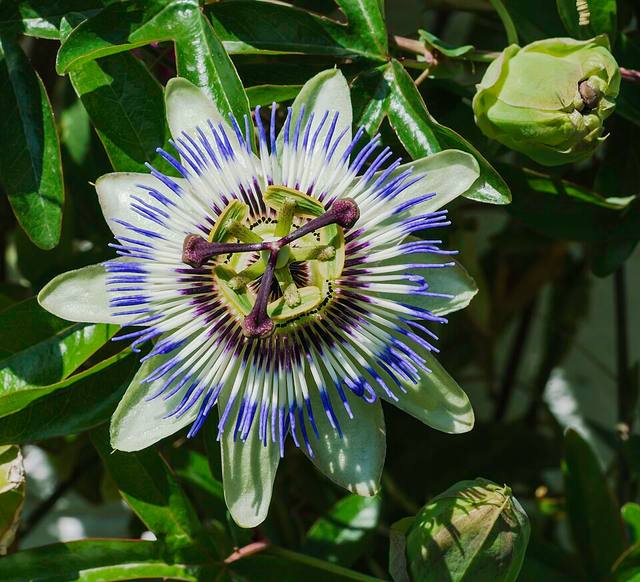
Photo: Franz van Duns · CC BY-SA 4.0 · Wikimedia Commons

Blue passion flower
Passiflora caerulea
Also called Common passion flower, Blue crown passion flower
Garden flower · Family Passifloraceae · Native to South America (Argentina, Brazil, Paraguay, Peru)
A vigorous, climbing vine with five-lobed leaves and intricate blue and white flowers in summer. It is among the hardiest passion flowers and has orange fruit.
Not on the ASPCA's list: keep it out of reach of pets.
Care
Light
Full sun
Needs full sun to part shade, with at least 5 to 6 hours of sun for flowers. In deep shade it grows leaves but few flowers. A sheltered, warm wall suits it.
Water
About every 5 days in the growing season, every 14 in the cool season
Water deeply in dry weather, especially in pots, and let the top dry between waterings. Established plants in the ground cope with drought. Water less in winter.
Water when the top 3 cm (1 in) of soil is dry
Humidity
Medium humidity
Normal outdoor humidity is fine.
Temperature
10 to 30 °C (50 to 86 °F)
Grows best at 10 to 30 °C (50 to 86 °F). Frost cuts back the leaves and stems near -7 °C (19 °F), but the roots often regrow in spring.
Soil
A well-drained, ordinary garden soil. It flowers better in poor soil. Use a free-draining potting mix in pots.
Feeding
Every 4 weeks in the growing season
Feed every 4 weeks in summer with a feed high in potash. Too much nitrogen gives leaves and few flowers.
Repotting
Not usually divided. Pot-grown plants can go into a bigger pot every 2 or 3 years in spring.
Pruning
Prune in spring: cut back old growth by about a third, and remove dead, tangled and frost-damaged stems. Wear gloves, as the sap can irritate skin for some people.
Propagation
Take softwood cuttings in summer and root them in damp gritty mix. It also self-seeds. Layering stems into the soil also works.
Size
300 to 1000 cm (118 to 394 in)
Fast growing
Outdoors
USDA zones 8 to 10
Grows outdoors on a sunny wall or fence in mild areas, with a trellis to climb. In colder areas it dies back and returns, or is kept in a pot.
Eating
Ripe orange fruit (bland)
Leave the leaves and stems alone. Eat only fully ripe fruit.
Common problems
No flowers
Too much shade or too much feed
Give it full sun and a feed high in potash, not nitrogen.
Leaves yellow and drop
Cold, wet roots or hunger
Check the drainage. Feed in the growing season.
Stems die after frost
Frost
Cut dead stems back in spring when new growth shows.
Sticky leaves, small insects
Aphids
Rinse off with water or wipe with soapy water.
Webs and speckled leaves
Spider mites
Rinse the leaves and raise humidity.
Did you know?
The flower is a symbol of the Passion of Christ: early Spanish missionaries saw the crown of thorns in the fringe and the nails in the styles. The fruit is edible but bland.
General care information for a typical plant. Conditions in your home or garden may need a different rhythm.
Not sure what your plant is?
Identify a plant from a photoSee this guide in the appKagn Plants also keeps your own plants with watering reminders, and its plant doctor reads what is wrong with one.
Updated 22 November 2026.