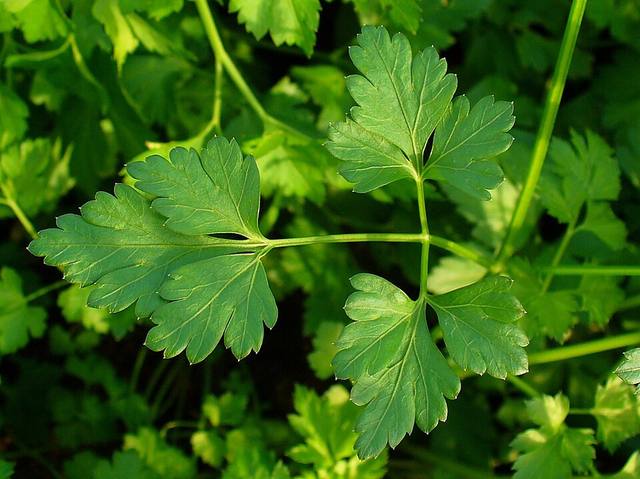
Photo: H. Zell · CC BY-SA 3.0 · Wikimedia Commons

Parsley
Petroselinum crispum
Also called Curly parsley, Flat-leaf parsley, Italian parsley
Herb · Family Apiaceae · Native to Mediterranean region
A leafy herb with curly or flat leaves used in cooking. It is a biennial that is usually grown for one season and goes to seed in its second year.
Toxic to cats and dogs
Toxic principle: Furanocoumarins
Signs: Photosensitization (sunburn, dermatitis), large amounts are needed to cause this effect
Care
Light
Part sun
Full sun in cool climates, part shade in hot ones. A bright windowsill indoors. Weak light gives leggy, pale stems.
Water
About every 4 days in the growing season, every 8 in the cool season
Keep the soil evenly moist, as it has a deep taproot and bolts if stressed. Do not let the pot sit in water. Water less in winter when growth is slow.
Water when the top 2 cm (1 in) of soil is dry
Humidity
Medium humidity
Normal humidity. Dry heat makes it bolt or turn yellow.
Temperature
10 to 24 °C (50 to 75 °F)
Best at 10 to 24 °C (50 to 75 °F). Hardy to about -10 °C (14 °F) outside, but leaves stop growing in a hard frost.
Soil
Rich, moist, well-drained soil, pH 6 to 7. It needs a deep pot of at least 20 cm (8 in) for the taproot.
Feeding
Every 4 weeks in the growing season
Feed with a general fertiliser every 4 weeks in the growing season. Cut leaves regularly.
Repotting
Biennial: sow each spring or autumn. A pot plant resents transplanting, so move it once, with little root disturbance.
Pruning
Cut the outer stems at the base first, leaving the centre to grow. Remove flower stalks in year two to extend the harvest.
Propagation
Sow seed in spring or autumn, 1 cm (0.5 in) deep. It is slow: soak seed overnight, and expect 3 to 6 weeks to sprout.
Size
20 to 60 cm (8 to 24 in)
Medium growth
Outdoors
USDA zones 5 to 9
Hardy biennial in a sunny to part-shade, moist spot; sow in early spring or late summer, 20 to 25 cm (8 to 10 in) apart.
Eating
Leaves and stems
Do not confuse with poison hemlock or fool's parsley, which look similar and are poisonous.
Common problems
Yellow leaves
Overwatering, hunger or old plant
Let the top dry between waterings and feed lightly.
Flower stalks in year two
Bolting
Pull and resow; leaves turn bitter once it flowers.
Seeds do not sprout
Slow seeds, cold soil
Soak seed overnight and keep the soil moist and warm.
Brown leaf spots
Leaf spot disease
Remove spotted leaves, water the soil and improve airflow.
Chewed leaves, striped caterpillars
Swallowtail caterpillars
Move them to another plant, or accept some losses.
Did you know?
Parsley needs a very long time to sprout, which gave rise to the old saying that it goes to the Devil nine times before it comes up.
General care information for a typical plant. Conditions in your home or garden may need a different rhythm.
Not sure what your plant is?
Identify a plant from a photoSee this guide in the appKagn Plants also keeps your own plants with watering reminders, and its plant doctor reads what is wrong with one.
Updated 22 November 2026.