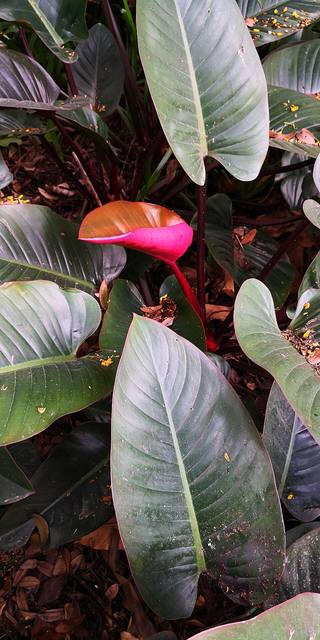
Photo: Alialb · CC BY-SA 4.0 · Wikimedia Commons

Blushing philodendron
Philodendron erubescens
Also called Pink princess, Red-leaf philodendron, Burgundy philodendron
Houseplant · Family Araceae · Native to Colombia
A climbing philodendron with large, glossy heart-shaped leaves and red stems. 'Pink Princess' is a form with pink and dark leaves that is highly prized.
Toxic to cats and dogs
Toxic principle: Insoluble calcium oxalates
Signs: Oral irritation, pain and swelling of mouth, tongue and lips, drooling, vomiting, difficulty swallowing
Care
Light
Bright, indirect light
Bright indirect light. The pink in 'Pink Princess' fades in low light, and direct sun scorches. Give a moss pole and it climbs and its leaves get bigger.
Water
About every 8 days in the growing season, every 14 in the cool season
Water well and let the top dry. It dislikes soggy soil. Cold, wet roots cause yellow leaves and rot. Keep the soil even.
Water when the top 5 cm (2 in) of soil is dry
Humidity
Medium humidity
Average humidity is fine, but it grows bigger and better in moist air. Brown tips mean the air is too dry.
Temperature
18 to 29 °C (64 to 84 °F)
Keep at 18 to 29 °C (64 to 84 °F). It is damaged below about 12 °C (54 °F).
Soil
Chunky aroid mix: houseplant compost with bark and perlite. The pot needs drainage holes.
Feeding
Every 4 weeks in the growing season
Feed every 4 weeks in spring and summer with a diluted houseplant fertiliser. Pause in winter.
Repotting
Every 2 years
Repot every 2 years in spring, one size up. Wear gloves, as the sap can irritate skin.
Pruning
Cut stems above a node to keep it bushy. Variegated stems that revert to all green should be cut back to a pink-leaved node.
Propagation
Cut a stem below a node with 1 or 2 leaves and root it in water or damp mix in 3 to 5 weeks. Variegated cuttings need a node that carries pink.
Size
60 to 200 cm (24 to 79 in)
Medium growth
Outdoors
USDA zones 10 to 12
Only outdoors in frost-free, shaded and humid gardens. It is usually grown as a houseplant.
Common problems
Pink or white variegation fades
Too little light
Move to brighter indirect light and trim back reverted stems.
Yellow leaves
Overwatering
Let the top 5 cm dry; check the pot drains.
Brown leaf edges
Dry air or cold draughts
Move it away from vents and raise humidity.
Small, widely spaced leaves
Low light or no support
Give a moss pole and brighter light.
Brown, crispy new leaves
Sun scorch
Move out of direct sun.
Did you know?
The 'Pink Princess' is a chimera: its pink patches come from cells that lack chlorophyll, which makes each plant's pattern different and the colour unstable.
General care information for a typical plant. Conditions in your home or garden may need a different rhythm.
Not sure what your plant is?
Identify a plant from a photoSee this guide in the appKagn Plants also keeps your own plants with watering reminders, and its plant doctor reads what is wrong with one.
Updated 22 November 2026.