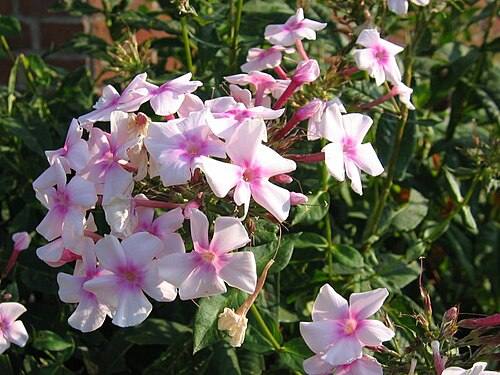
Photo: Kristian Peters -- Fabelfroh 08:34, 24 September 2005 (UTC) · CC BY-SA 3.0 · Wikimedia Commons

Garden phlox
Phlox paniculata
Also called Tall phlox, Summer phlox, Fall phlox
Garden flower · Family Polemoniaceae · Native to Eastern United States
A tall perennial with big, scented heads of pink, purple or white flowers from midsummer. Butterflies and hummingbirds visit, and it forms a clump that returns every year.
Not on the ASPCA's list: keep it out of reach of pets.
Care
Light
Full sun
Full sun or light shade. More shade means less flower and more mildew. Good air flow is important.
Water
About every 5 days in the growing season, every 30 in the cool season
Water deeply once a week in dry spells, at the base. Dry roots stress it and bring mildew. Water less in winter, when it rests.
Water when the top 5 cm (2 in) of soil is dry
Humidity
Medium humidity
Outdoor humidity is no concern, but damp, still air brings mildew. Give each clump space.
Temperature
10 to 27 °C (50 to 81 °F)
Hardy to about -40 °C (-40 °F). Best at 10 to 27 °C (50 to 81 °F). Heat with drought stresses it.
Soil
Rich, moisture-retentive but well-drained soil with plenty of compost. Neutral to slightly acid. Add mulch.
Feeding
Every 4 weeks in the growing season
Feed every 4 weeks in spring and early summer, or mulch with compost in spring.
Repotting
Every 4 years
Divide every 3 to 5 years in early spring or autumn. The newer outer pieces are best.
Pruning
Thin shoots to 5 to 7 stems per clump in spring to improve air flow. Cut off spent flower heads to extend flowering. Cut to the ground in autumn.
Propagation
Divide clumps in spring or autumn, or take root cuttings in winter. Seedlings from seed varieties vary in colour.
Size
60 to 120 cm (24 to 47 in)
Medium growth
Outdoors
USDA zones 3 to 8
Hardy in zones 3 to 8. Plant 45 to 60 cm (18 to 24 in) apart in sun with air movement. Choose mildew-resistant types.
Common problems
White powder on leaves
Powdery mildew
Thin shoots, water at the base and choose mildew-resistant types.
Lower leaves brown and drop
Dry soil or mildew
Water deeply, mulch and thin the stems.
Flowers fade to a muddy colour
Heat or old flowers
Deadhead spent heads often. Plant in morning sun and afternoon shade.
Stems fall over
Shade or rich soil
Stake, or plant in full sun with poorer soil.
Twisted, thin leaves
Stem and bulb nematodes or mite
Remove and bin affected shoots. Do not compost.
Did you know?
Garden phlox was one of the first American wildflowers taken to Europe, and breeders in England and Germany improved it from the 1800s.
General care information for a typical plant. Conditions in your home or garden may need a different rhythm.
Not sure what your plant is?
Identify a plant from a photoSee this guide in the appKagn Plants also keeps your own plants with watering reminders, and its plant doctor reads what is wrong with one.
Updated 22 November 2026.