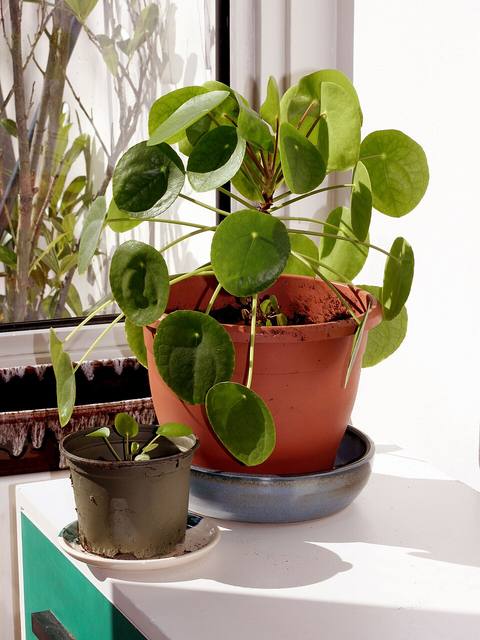
Photo: Husky · CC0 · Wikimedia Commons

Chinese money plant
Pilea peperomioides
Also called Pancake plant, UFO plant, Missionary plant, Friendship plant
Houseplant · Family Urticaceae · Native to Yunnan and Sichuan, southwestern China
A quirky plant with round, coin-shaped leaves on long stalks. It makes lots of baby plants, which people share with friends.
Not on the ASPCA's list: keep it out of reach of pets.
Care
Light
Bright, indirect light
Bright indirect light. Rotate it so leaves grow evenly: it leans toward the window. Direct sun burns the leaves; low light gives small leaves.
Water
About every 8 days in the growing season, every 16 in the cool season
Water thoroughly and drain. Drooping, curled leaves can mean thirst or wet roots. Use room-temperature water and avoid getting the leaves wet in cold rooms.
Water when the top 5 cm (2 in) of soil is dry
Humidity
Medium humidity
Average humidity is fine. It dislikes cold draughts more than dry air.
Temperature
15 to 24 °C (59 to 75 °F)
Best at 15 to 24 °C (59 to 75 °F). Below 10 °C (50 °F) the leaves are damaged.
Soil
Light, airy potting mix with perlite. The pot must drain; overly dense soil causes root rot.
Feeding
Every 4 weeks in the growing season
Feed every 4 weeks in spring and summer with a half-strength fertiliser. None in winter.
Repotting
Every 2 years
Repot every 1 to 2 years in spring as it grows, or when babies crowd the pot.
Pruning
Pinch off dead leaves. Remove pups to keep the main plant tidy.
Propagation
Cut off the baby plants (pups) with a bit of root when 5 cm (2 in) tall and pot them up, or root in water.
Size
20 to 40 cm (8 to 16 in)
Medium growth
Outdoors
USDA zones 9 to 11
Outdoors only in mild, frost-free places in bright shade. Mostly grown as a houseplant.
Common problems
Curled or drooping leaves
Overwatering, underwatering or cold
Check the soil: water if dry, let it dry if wet, and keep it warm.
Leaning plant
Light from one side
Rotate the pot a quarter turn each week.
Brown spots or scorched leaves
Direct sun
Move to bright indirect light.
Yellow lower leaves
Natural ageing or overwatering
Remove old leaves; water less if many.
Small, pale leaves
Low light
Move to a brighter spot.
Did you know?
It was brought to Europe in 1946 by a Norwegian missionary and shared as cuttings, which is why it spread by gift long before it was sold in shops.
General care information for a typical plant. Conditions in your home or garden may need a different rhythm.
Not sure what your plant is?
Identify a plant from a photoSee this guide in the appKagn Plants also keeps your own plants with watering reminders, and its plant doctor reads what is wrong with one.
Updated 22 November 2026.