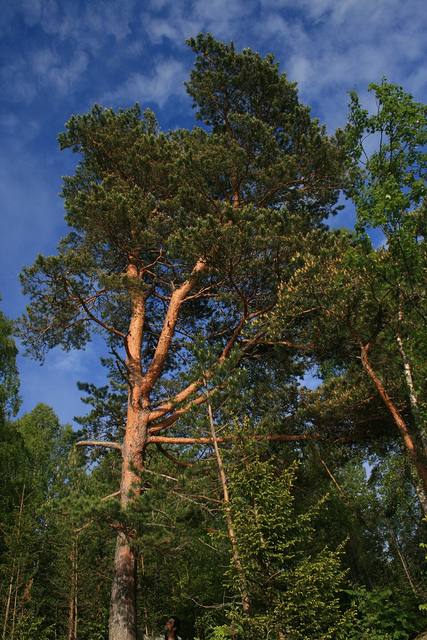
Photo: Mickaël Delcey (Silverkey) · CC BY-SA 3.0 · Wikimedia Commons

Scots pine
Pinus sylvestris
Also called Scotch pine, Baltic pine
Tree · Family Pinaceae · Native to Europe and northern Asia
A tough, evergreen pine with orange-red upper bark and blue-green twisted needles in pairs. It grows on poor soil from the coast to the mountains.
Not on the ASPCA's list: keep it out of reach of pets.
Care
Light
Full sun
Needs full sun. It will not grow in shade, and lower branches die back.
Water
About every 14 days in the growing season, every 30 in the cool season
Water new trees weekly in the first summer, then rarely. Established trees survive drought. Evergreen, so water new trees monthly in a dry winter.
Water young trees every 7 to 14 days in dry weather
Humidity
Low humidity
Outdoor humidity is no concern. It does well in dry air.
Temperature
8 to 25 °C (46 to 77 °F)
Hardy to about -45 °C (-49 °F). Grows best at 8 to 25 °C (46 to 77 °F). One of the hardiest conifers.
Soil
Light, free-draining, acid to neutral soil such as sand or gravel. It dislikes heavy, wet clay and shade.
Feeding
Do not feed. Fertiliser makes brittle, soft growth.
Repotting
Plant it in the ground as a small tree. The long taproot dislikes disturbance.
Pruning
Remove dead and low branches if needed in winter. Never cut back into bare wood: it does not shoot again from old wood.
Propagation
Sow seed in spring from cones that have been opened in warmth. Named dwarf forms are grafted.
Size
1500 to 3000 cm (591 to 1181 in)
Medium growth
Outdoors
USDA zones 2 to 8
Needs 6 to 8 m (20 to 26 ft) of space. Good for coastal, windy and sandy sites. Keep clear of buildings.
Common problems
Needles turn orange and drop in autumn
Normal shedding of the oldest needles
Inner needles fall after 2 or 3 years. Only worry if the whole crown browns.
Brown shoots in spring
Pine needle blight or frost
Cut off dead tips and improve air flow.
White fluffy patches on bark
Pine adelgid (aphid-like insect)
Spray off with water or oil in summer. Healthy trees tolerate it.
Tips die and the crown thins
Drought or root damage in a pot-grown tree
Water deeply in the first summers and mulch.
Resin bleeding from the trunk
Wound or pest
Usually harmless. If many drips appear, ask a tree officer.
Did you know?
Scots pine is Scotland's national tree. The ancient Caledonian forest is now only a few remnants, but individual pines there are 250 to 400 years old.
General care information for a typical plant. Conditions in your home or garden may need a different rhythm.
Not sure what your plant is?
Identify a plant from a photoSee this guide in the appKagn Plants also keeps your own plants with watering reminders, and its plant doctor reads what is wrong with one.
Updated 22 November 2026.