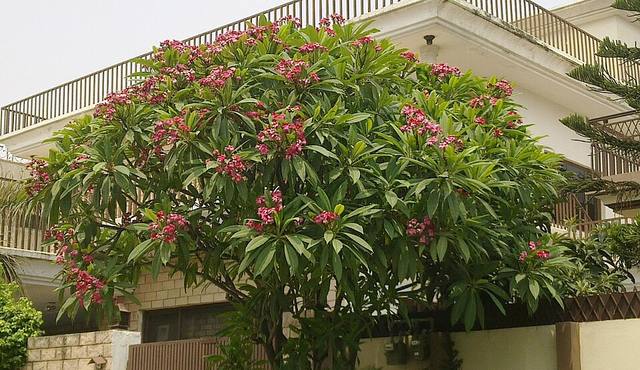
Photo: Gul Kiyani · CC BY 3.0 · Wikimedia Commons

Frangipani
Plumeria rubra
Also called Plumeria, Temple tree, Red frangipani
Tree · Family Apocynaceae · Native to Mexico, Central America
A small tropical tree with thick, bare branches and clusters of very fragrant flowers in pink, white, yellow or red. It loses its leaves in winter and rests.
Not on the ASPCA's list: keep it out of reach of pets.
Care
Light
Full sun
Full sun, at least 6 hours, to flower. In low light it becomes leggy and flowers poorly. Indoors, the sunniest window, ideally outside in summer.
Water
About every 7 days in the growing season, every 35 in the cool season
Water well in the growing season but let it dry between. Stop when it drops leaves in cooler weather; a dormant plant needs almost no water and rots if kept wet.
Water when the soil is dry to 5 cm (2 in) deep
Humidity
Low humidity
Dry air is fine. Wet foliage in cool weather can encourage rust.
Temperature
18 to 35 °C (64 to 95 °F)
Best at 18 to 35 °C (64 to 95 °F). Damaged by frost and cold, wet soil below about 10 °C (50 °F).
Soil
Very free-draining, gritty mix, such as cactus compost with perlite or sand. Slightly acidic. Drainage holes are essential.
Feeding
Every 3 weeks in the growing season
Feed every 3 to 4 weeks in spring and summer with a high-phosphorus fertiliser to help flowers. Not in winter.
Repotting
Every 2 years
Repot every 2 years in spring, once it is rootbound. Use a pot with excellent drainage. Wear gloves; the milky sap can irritate skin.
Pruning
Prune in late winter or early spring before growth, to shape, as flowers appear on branch tips. Wear gloves, as the sap irritates.
Propagation
Take a 30 cm (12 in) tip cutting in spring or summer, leave the cut to dry for a week or more, then plant in dry gritty mix. Water lightly once roots form, in 4 to 8 weeks.
Size
200 to 600 cm (79 to 236 in)
Medium growth
Outdoors
USDA zones 10 to 12
Grows outdoors in frost-free, hot gardens in full sun, well drained. Space 3 to 5 m (10 to 16 ft). In cooler areas grow in a pot, kept dry indoors in winter.
Common problems
Leaves yellow and drop in autumn
Normal winter dormancy
Reduce water and let it rest.
No flowers
Too little sun, too young, or too much nitrogen
Give full sun and a high-phosphorus feed.
Soft, black stem base
Rot from overwatering
Cut above rot, let dry and root again.
Orange powdery spots under leaves
Frangipani rust
Remove leaves and keep them dry.
Cutting does not root
Rotted before rooting
Let the cut dry well; use dry gritty mix and warmth.
Did you know?
Each flower has no nectar. It cheats hawkmoths, which pollinate it only by being fooled by the scent.
General care information for a typical plant. Conditions in your home or garden may need a different rhythm.
Not sure what your plant is?
Identify a plant from a photoSee this guide in the appKagn Plants also keeps your own plants with watering reminders, and its plant doctor reads what is wrong with one.
Updated 22 November 2026.