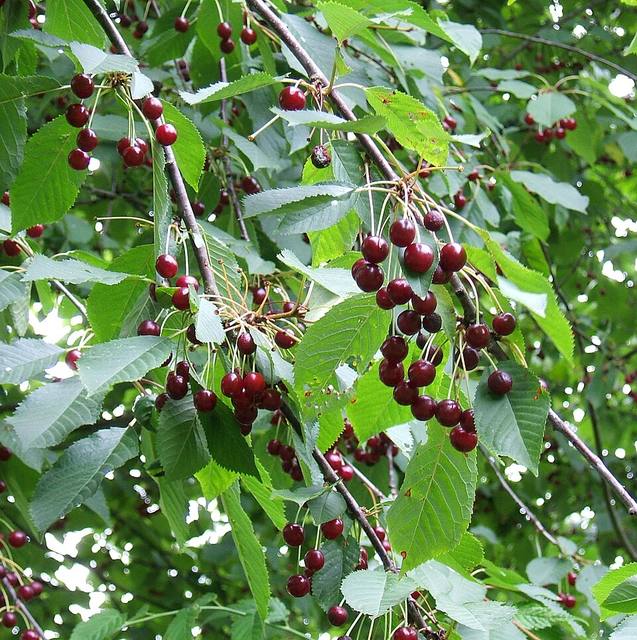
Photo: MPF · CC BY 2.5 · Wikimedia Commons

Sweet cherry
Prunus avium
Also called Cherry, Wild cherry, Gean, Mazzard
Tree · Family Rosaceae · Native to Europe and western Asia
A fast, tall tree with white spring blossom, sweet summer cherries and red autumn leaves. Most garden trees are grafted on a dwarf root and need a partner.
Toxic to cats and dogs
Toxic principle: Cyanogenic glycosides found in some species
Signs: Stems, leaves, seeds contain cyanide, particularly toxic in the process of wilting: brick red mucous membranes, dilated pupils, difficulty breathing, panting, shock
Care
Light
Full sun
Needs full sun and shelter. Shade gives weak growth and few cherries. Blossom is easily lost to late spring frost.
Water
About every 10 days in the growing season, every 21 in the cool season
Water young trees every 10 days in dry weather. Established trees seldom need extra, but a soak after a long dry spell stops fruit splitting. Winter days apply to the dormant tree.
Water when the top 5 cm (2 in) of soil is dry
Humidity
Medium humidity
Outdoor air is fine. Wet weather as fruit ripens causes splitting and brown rot.
Temperature
10 to 28 °C (50 to 82 °F)
Hardy to about -25 °C (-13 °F) when dormant; blossom dies below about -2 °C (28 °F). Grows best at 10 to 28 °C (50 to 82 °F). It needs winter chill.
Soil
Deep, fertile, well-drained loam, pH 6 to 7.5. It dislikes heavy wet clay and shallow chalk.
Feeding
Mulch with compost each spring and feed with a balanced fertiliser in early spring. Too much nitrogen gives soft growth and canker.
Repotting
Not repotted in the ground. A dwarf tree in a pot needs a bigger pot every 3 years and its topsoil renewed each spring.
Pruning
Prune only in summer, after fruiting, to avoid silver leaf and bacterial canker. Cut out dead and crossing branches and keep the tree open. Never prune in winter.
Propagation
Buy a grafted tree on a dwarfing rootstock and plant a compatible pollinator unless the variety is self-fertile. Cuttings do not root well.
Size
400 to 1200 cm (157 to 472 in)
Fast growing
Outdoors
USDA zones 4 to 9
Grows outdoors in a sunny, sheltered spot; fan-train a dwarf on a wall. Standards need 8 m (26 ft) of space. Net against birds.
Eating
Ripe flesh of the fruit
The stone and the leaves contain cyanide-producing compounds; do not chew the stones and keep them away from pets and children.
Common problems
Gum oozing, leaves with holes and brown spots
Bacterial canker
Prune only in summer, cut out affected branches and keep the tree healthy.
Fruit splits
Rain after a dry spell
Water evenly and cover with a rain shelter if possible.
Blossom, no fruit
Late frost or no pollinator
Protect blossom with fleece; plant a compatible partner variety.
Black aphids curling leaves
Cherry blackfly
Wash off with a hose or pick off the shoot tips.
Fruit stolen
Birds
Net the tree as the cherries redden.
Did you know?
Sweet cherry trees can live over 100 years, and wild cherry is among the first trees to blossom in spring.
General care information for a typical plant. Conditions in your home or garden may need a different rhythm.
Not sure what your plant is?
Identify a plant from a photoSee this guide in the appKagn Plants also keeps your own plants with watering reminders, and its plant doctor reads what is wrong with one.
Updated 22 November 2026.