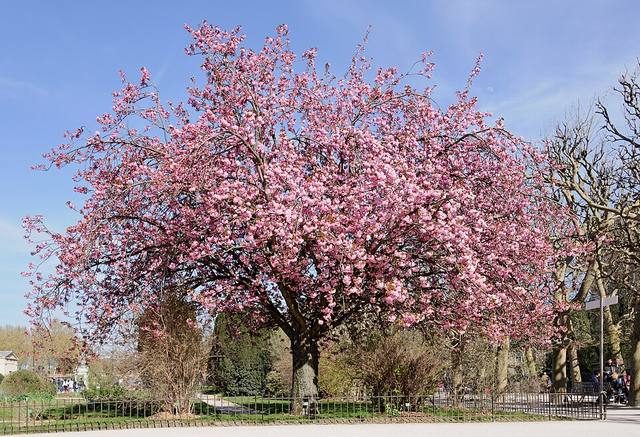
Photo: Myrabella · CC BY-SA 3.0 · Wikimedia Commons

Japanese flowering cherry
Prunus serrulata
Also called Oriental cherry, Sakura, Hill cherry
Tree · Family Rosaceae · Native to Japan, Korea and China
A spring-flowering tree covered in pink or white blossom before or with the leaves. It is the source of the cherry blossom festivals of Japan.
Toxic to cats and dogs
Toxic principle: Cyanogenic glycosides
Signs: Stems, leaves and seeds contain cyanide, particularly toxic when wilted: brick red mucous membranes, dilated pupils, difficulty breathing, panting, shock
Care
Light
Full sun
Needs full sun for good flowering. It tolerates light shade but flowers less.
Water
About every 10 days in the growing season, every 30 in the cool season
Water new trees deeply weekly in dry weather for 2 years. Established trees need little. It is deciduous, so water only in a very dry winter.
Water young trees every 7 to 10 days in dry weather
Humidity
Medium humidity
Outdoor humidity is no concern. Wet, humid springs bring blossom wilt and fungal spots.
Temperature
8 to 25 °C (46 to 77 °F)
Hardy to about -30 °C (-22 °F). Grows best at 8 to 25 °C (46 to 77 °F). Frost can spoil open blossom.
Soil
Well-drained, fertile, neutral to slightly acid soil. It hates waterlogging and compacted ground.
Feeding
Do not feed in most soils. A light spring dressing of balanced feed helps trees on poor soil.
Repotting
Plant in the ground. It does not suit a pot long term.
Pruning
Prune only in summer (June to August) to avoid silver leaf and bacterial canker. Cut out dead, crossing or diseased branches and leave the shape alone.
Propagation
Named trees are grafted onto cherry rootstock. Seedlings vary and do not match the parent.
Size
400 to 1000 cm (157 to 394 in)
Medium growth
Outdoors
USDA zones 5 to 8
Plant in full sun in a sheltered spot, 6 to 8 m (20 to 26 ft) from buildings. Many cultivars exist, from upright to weeping.
Common problems
Blossom turns brown and dies
Frost, wet weather or blossom wilt (Monilinia)
Cut off affected twigs in dry weather. Plant in a sheltered place.
Leaves have holes
Shot hole or bacterial canker
Prune in summer only, cut out cankers and avoid wounds.
Sticky gum oozing from the trunk
Bacterial canker or borers
Do not wound the trunk in winter. Cut out dead wood in summer.
Silvery leaves and dead branches
Silver leaf fungus
Cut back to healthy wood in summer and burn the infected pieces.
Sticky leaves and curled shoots
Aphids
Spray off with water or soapy water.
Did you know?
Washington, D.C. has about 3,000 Japanese cherry trees, a gift from Tokyo in 1912. Their blossom each spring is one of the city's best-known sights.
General care information for a typical plant. Conditions in your home or garden may need a different rhythm.
Not sure what your plant is?
Identify a plant from a photoSee this guide in the appKagn Plants also keeps your own plants with watering reminders, and its plant doctor reads what is wrong with one.
Updated 22 November 2026.